
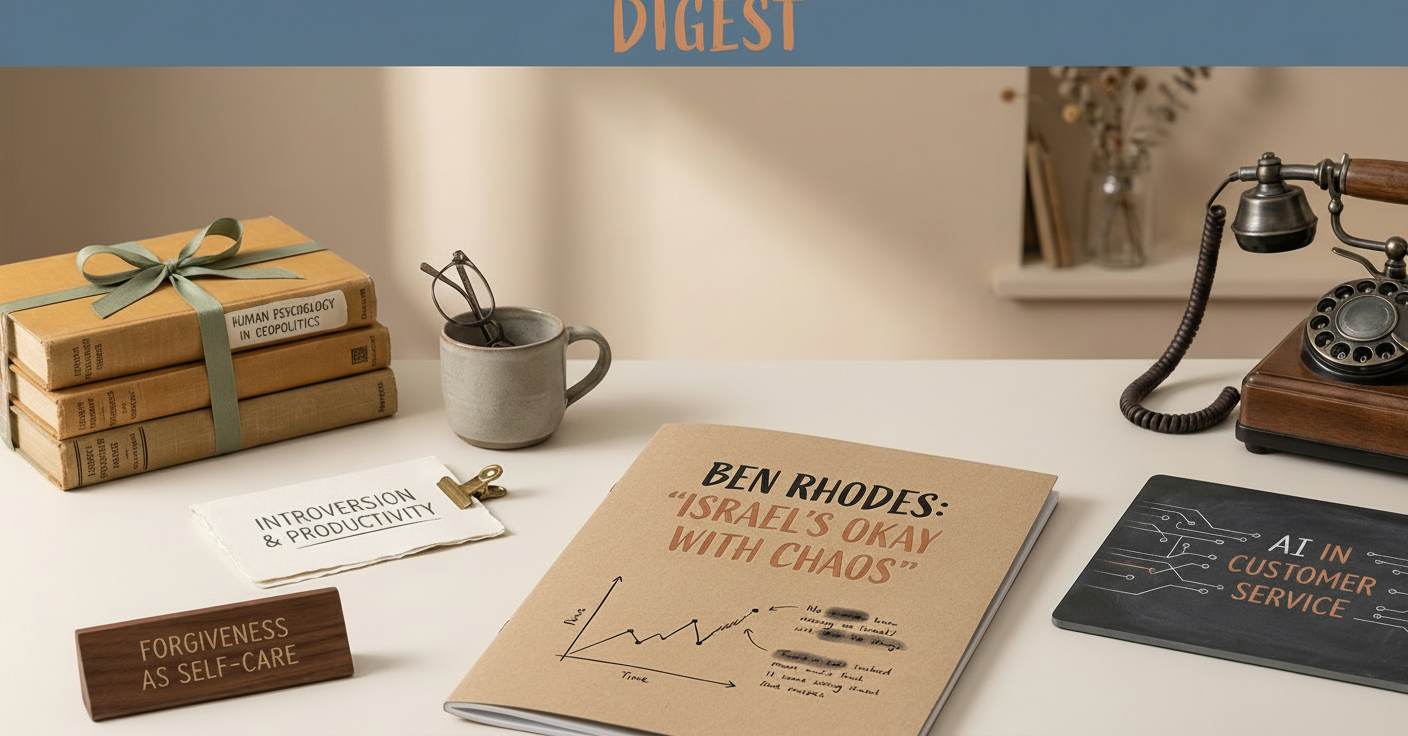
The deepest questions of foreign policy, personal fulfillment, and relational dynamics are being re-evaluated through the lens of human psychology. And it feels like a reckoning.
The Intake
📊 12 episodes across 10 podcasts
⏱ 719 minutes of intelligence analyzed
🎙 Featuring: Ezra Klein, Ben Rhodes, AG Sulzberger, James Sexton, Susan Cain, Vlad Tenev, Molly Worthen, Dr. Eric Solomon
The Big Shift
The Human Element is Not Just Soft Skills, It's the Hard Problem in Geopolitics, Business, and Relationships
This week's conversations reveal a profound re-centering on the human element, not as a 'soft skill' add-on, but as the core variable shaping outcomes across vastly different domains. From the destabilizing impact of emotionally-driven foreign policy decisions to the physiological roots of daily productivity and the overlooked relational baggage individuals bring to work, the current dialogue suggests that understanding human psychology—its biases, needs, and vulnerabilities—is no longer tangential, but fundamental. This isn't about mere empathy; it's about strategic clarity.
On the geopolitical front, the discussion around Trump's "head on a pike" foreign policy highlights how a focus on short-term, emotionally resonant outcomes can ignore the complex, long-term human consequences. Ben Rhodes (New York Times Opinion / Pod Save the World), discussing the military assault on Iran, emphasized the potential for vast refugee flows and civil conflict, cautioning:
"If you have a civil conflict inside of Iran, the economy's already in really deep trouble because of U.S. sanctions, a collapsing currency. So there's extreme poverty there. There are ethnic separatist movements inside of Iran."
— Ben Rhodes, Contributing Writer at New York Times Opinion on The Ezra Klein Show
This perspective underscores how a failure to anticipate human behavioral responses to extreme pressure can create unforeseen chaos, rather than achieving intended strategic goals. Similarly, within organizations, Esther Perel (Psychotherapist, ReThinking) and Adam Grant (Host, TED) explored the concept of "unofficial resumes," highlighting how personal relationship histories shape professional interactions. Their argument is that these deeply human, often unarticulated, patterns aren't just cultural quirks; they dictate success or failure in team dynamics and organizational mergers, often outweighing technical capabilities.
The recurring thread is this: whether it's understanding the energy expenditure of introverts (Susan Cain on EconTalk), the subtle psychological tolls of constant phone use (Mel Robbins on The Mel Robbins Podcast), or the emotional manipulation tactics in relationships (James Sexton on The Mel Robbins Podcast), ignoring these deeply human factors is not just negligent—it's strategically unsound. The shift is towards recognizing emotion, mindset, and deeply ingrained psychological patterns as high-leverage points for intervention and strategy. As Dr. Alia Crum (Professor, Director of Stanford Mind & Body Lab) noted, "Our mindsets change what we pay attention to." This internal operating system, individual and collective, is what truly determines outcomes.
The Rundown
① Mindset is a Physiological Lever. Your first microchoice of the day sets a physiological trajectory that impacts energy and focus. Early phone scrolling depletes neurological resources faster than difficult tasks. (Mel Robbins on The Mel Robbins Podcast)
→ The implication: Implement "strategic phone placement" and pre-set morning routines to conserve dopamine for more challenging, rewarding work, improving daily productivity and focus.
② Relational Baggage Drives Organizational Outcomes. The "unofficial resume" of past relationship experiences and cultural socialization profoundly impacts workplace interactions and organizational success, often more than formal qualifications. (Esther Perel on Worklife with Adam Grant)
→ The strategic question: Leaders must understand and address these hidden dynamics, fostering cultures that can integrate diverse relational histories rather than allowing them to polarize teams.
③ Introversion's Power is Underestimated. Introverts possess nervous systems that react more intensely to stimulation, making them thrive in less overwhelming environments and excel in deep contemplation and individual idea generation. (Susan Cain on EconTalk)
→ The leadership insight: Create optimal work environments that balance solitary creative time with collaborative sharing, valuing deep work and individual contributions as much as open-plan brainstorming.
④ Authentic "Wholeness", Not Performance, Fuels Innovation. Bringing your "whole self to work" requires first being "whole"—owning one’s challenges and messiness, rather than presenting a perfect facade, which fosters psychological safety and creativity. (Amanda Slavin on From The Culture)
→ The cultural imperative: Leaders should prioritize psychological safety and create space for vulnerability, recognizing that allowing for "messiness" (without offloading it) unlocks greater team innovation.
⑤ Small Relational Failures Compound. Most marital breakdowns result from accumulated small mistakes and persistent inattention to a partner's needs, rather than single catastrophic events. (James Sexton on The Mel Robbins Podcast)
→ The actionable strategy: Implement regular, structured conversations where partners articulate what made them feel loved and what could have been better, fostering continuous, positive feedback loops.
⑥ AI-Driven Customer Service is Already Best-in-Class for Some. Robinhood's customer service leverages AI agents that operate in the most advanced, "non-read-only" categorizations, setting a new benchmark for efficiency and personalization. (Vlad Tenev on The Knowledge Project)
→ The operational model: Companies should rapidly assess their customer service operations for AI integration, recognizing that best-in-class performance now includes sophisticated AI agents capable of dynamic interaction.
⑦ Geopolitical Chaos Can Be a Strategic Advantage. Some actors, like Israel, may tolerate or even find advantage in regional instability (e.g., an implosion in Iran) if it disrupts perceived threats to their security. Ben Rhodes (New York Times Opinion / Pod Save the World) noted that "Israel's okay with chaos" on The Ezra Klein Show.
→ The counter-intuitive warning: Assume that seemingly irrational or destabilizing actions by adversaries or allies may be deliberate, aiming to create chaos that benefits their long-term security calculations.
Signal Board
🔥 HEATING UP
• Mindset Influence on Physiological Response: Dr. Crum's research shows that believing it will be a good day physically prepares the body for positivity. (Mel Robbins on The Mel Robbins Podcast)
• Psychological Safety 🆕: Recognized as the #1 factor for team success over individual talent, emphasizing its centrality to innovation. (Eric Solomon on From The Culture)
• AI in Customer Service 🆕: Robinhood's use of advanced AI agents is setting a new standard for efficient and personalized customer support. (Vlad Tenev on The Knowledge Project)
👀 ON WATCH
• Tokenization of Private Assets 🆕: Growing interest in making private markets accessible to retail investors through tokenization, facing regulatory hurdles. (Vlad Tenev on The Knowledge Project)
• Evolutionary Adaptation to Space 🆕: The potential for long-term Mars settlements to drive human evolutionary changes, including genetic mutations and new human "Martian nature". (Scott Solomon on Modern Wisdom)
• Culture of Character vs. Culture of Personality 🆕: A historical shift in societal values, moving from emphasizing internal virtues to external magnetism, visible in leadership and self-help. (Susan Cain on EconTalk)
❄️ COOLING OFF
• Conventional Leadership Charisma 🆕: While still impactful, its fundamental role is being questioned, with introverted leaders and narrative-driven influence gaining recognition. (Molly Worthen on Hidden Brain)
• Traditional Models of Forgiveness 🆕: The idea of forgiveness as an obligation is being challenged, reframed as a three-step process of self-care. (Tara Howley on The Art of Accomplishment)
• Economic 'War' with China 🆕: Critiqued as an inevitable (and potentially beneficial) economic rise for China, questioning the US's competitive stance. (Larry Kotlikoff on The Glenn Show)
The Tension
Should Forgiveness Be an Obligation or an Act of Self-Care?
The concept of forgiveness, often seen as a moral imperative, is being challenged and reframed through a lens of self-preservation and internal well-being rather than external obligation. This tension highlights differing views on its purpose and process.
🔵 Forgiveness as Self-Care:Tara Howley (Guest) provocatively stated, "Forgiveness is inherently an act of self care. And, and we've lost that. So I say fuck forgiveness." She advocates for a three-step process—processing emotions, cultivating curiosity, and setting clear boundaries—arguing that true forgiveness emerges as an inevitable byproduct, freeing the individual from resentment without condoning harmful behavior. This view emphasizes personal agency and emotional health.
🔴 The Moral/Relational Imperative: While not directly countered in this week's episodes, the traditional view of forgiveness often implies a moral responsibility, particularly in relationships, to let go of grudges for the sake of reconciliation or personal virtue. Many spiritual and societal teachings position forgiveness as a necessary step for peace, not just for the individual, but for restoring harmony between parties. This perspective often prioritizes the relational outcome.
What's at stake: The distinction matters for how individuals navigate trauma and interpersonal conflict; viewing forgiveness as self-care empowers individuals to establish boundaries and prioritize their well-being, potentially fostering more authentic healing, while the imperative view can lead to premature or coerced forgiveness that prolongs suffering.
The Bookshelf
Quiet: The Power of Introverts in a World That Can't Stop Talking by Susan Cain
Highly recommended by Susan Cain (Author, Author) on EconTalk, this book explores the nuanced definitions of introversion and extroversion, arguing for the underappreciated strengths of introverts in an overstimulating world.
How to Stay in Love by James Sexton
Authored by James Sexton (Divorce Attorney & Author) and discussed on The Mel Robbins Podcast, this book offers unconventional, practical advice for maintaining long-lasting relationships based on decades of observing why marriages succeed or fail.
From the Ruins of Empire by Pankaj Mishra
Mentioned for its historical context on global power shifts and anti-Western sentiment, this book offers perspective on the rise and fall of empires, providing valuable context for foreign policy discussions. (Mentioned on The Ezra Klein Show)
The World of Yesterday by Stefan Zweig
Recommended to provide context on the historical shifts in global power dynamics and cultural changes that inform current geopolitical thinking. (Mentioned on The Ezra Klein Show)
Your Move
Optimize Your Daily Rituals: Audit your first 30 minutes awake. Identify "dopamine squeezers" like phone scrolling and replace them with activities that build positive momentum, like hydration or deliberate planning. Delegate responsibility for implementing "strategic phone placement."
Expose Relational Baggage: Facilitate a team candid conversation (or 1:1s) about "unofficial resumes"—how past experiences and socialization unconsciously shape workplace behavior. Frame it as understanding team dynamics, not just individual personalities. This helps surface hidden tensions and potential blind spots.
Reframe Forgiveness as Self-Care: Discuss with your leadership team or HR how forgiveness can be reframed within organizational conflict resolution. Move away from prescriptive "forgive and forget" narratives towards empowering individuals to set boundaries and process emotions constructively.
Pilot AI in Customer Service: Task your operations lead with researching and piloting advanced AI agents for customer service. Explore vendors that operate beyond "read-only" capabilities, aiming for dynamic, interactive support, similar to Robinhood's approach.
📖 Want the full episode breakdowns, guest details, and listen links?
Quick Appendix
The Ezra Klein Show: "Trump’s Head-on-a-Pike Foreign Policy" · 71 min · Featuring Ezra Klein ▶ Listen
The Mel Robbins Podcast: "Try It For 1 Day: 4 Small Choices That Make a Surprisingly Huge Difference" · 61 min · Featuring Mel Robbins ▶ Listen
The Glenn Show: "February 2026 Q&A" · 2 min · Featuring Glenn Loury ▶ Listen
Worklife with Adam Grant: "ReThinking: Esther Perel on the relationship baggage we bring to work" · 37 min · Featuring Adam Grant ▶ Listen
EconTalk: "The Power of Introverts (with Susan Cain)" · 68 min · Featuring Russ Roberts ▶ Listen
The Knowledge Project: "Inside the Mind of Robinhood Co-Founder Vlad Tenev" · 111 min · Featuring Vlad Tenev ▶ Listen
From The Culture: "S1, E9 - Grief Wholeness and The Selves We Carry" · 62 min · Featuring Marcus Collins ▶ Listen
The Mel Robbins Podcast: "The Most Eye-Opening Conversation on Marriage & Love You Will Ever Hear (From #1 Divorce Lawyer)" · 96 min · Featuring Mel Robbins ▶ Listen
The Art of Accomplishment: "“I Learned Forgiveness by Refusing to Forgive” with Tara Howley and Alexa Kistler" · 31 min · Featuring Alexa Kistler ▶ Listen
Modern Wisdom: "#1065 - Scott Solomon - The Insane Biological Cost of Living on Mars" · 83 min · Featuring Chris Williamson ▶ Listen
The Glenn Show: "TGS Live: Larry Kotlikoff on Debt, Tariffs, and the Public Role of Economists" · 3 min · Featuring Glenn Loury ▶ Listen
Hidden Brain: "The Secret of Charisma" · 94 min · Featuring Shankar Vedantam ▶ Listen