
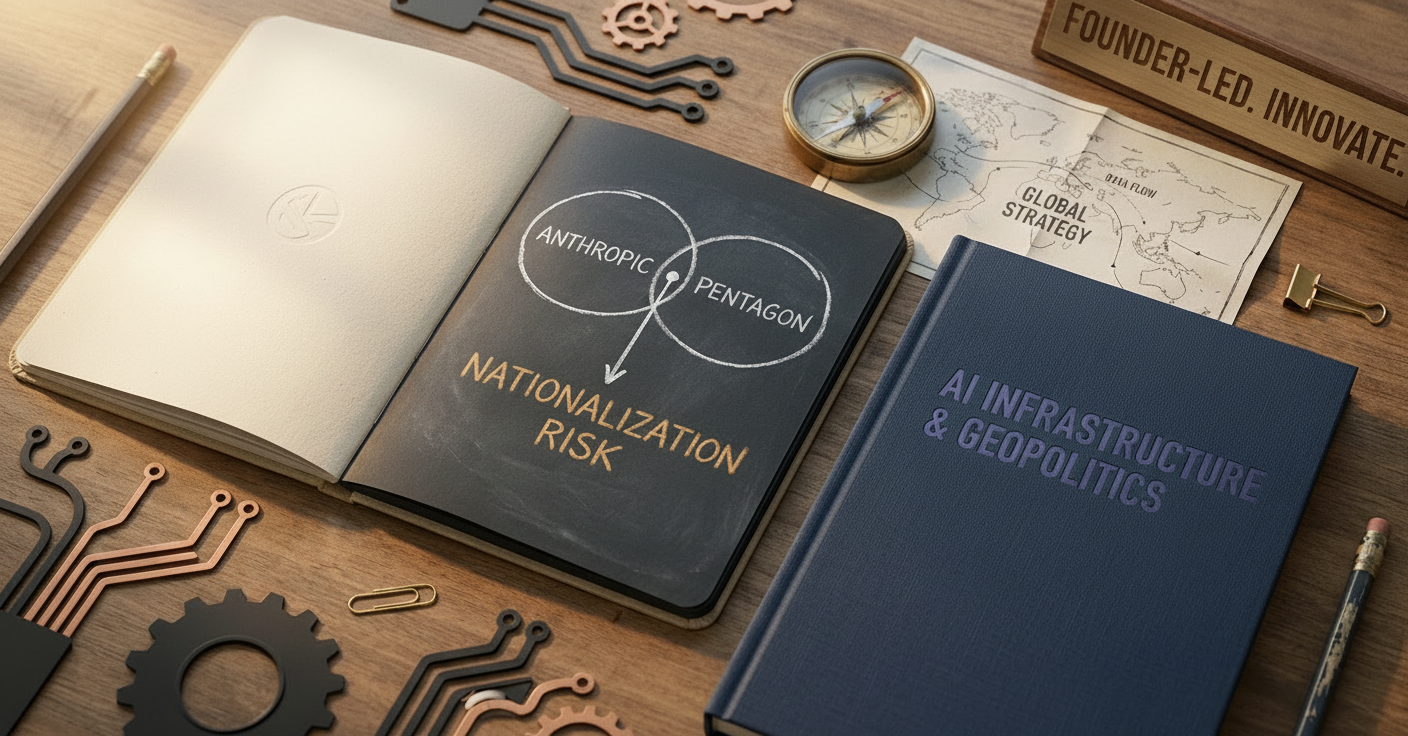
The AI industrial complex is clashing with national security—and venture capitalists are choosing sides.
📊 11 episodes across 7 podcasts
⏱ 740 minutes of intelligence analyzed
🎙 Featuring: Harry Stebbings, David Placek, Sam Parr, Shaan Puri
The Big Shift
The Zero-Sum AI Race Pits Tech's Values Against National Security's Demands
A profound tension is escalating between the open, values-driven culture of Silicon Valley and the hard realities of national defense, particularly in the critical domain of AI. This week, multiple discussions highlighted how AI companies, especially at the forefront of innovation like Anthropic, are being forced to confront geopolitical imperatives that clash with their stated ethical guidelines. The US government is putting unprecedented pressure on AI developers, with discussions around potentially blacklisting companies from federal contracts if their products aren't deemed "safe" for military use, or worse, facing nationalization if they don't align.
Alex Karp, Co-founder and CEO of Palantir, articulated this stark reality: "If AI companies don't make common cause with the defense establishment, nationalization becomes the politically obvious move." (Alex Karp on The a16z Show). This isn't just about government contracts; it's about the very future and control of frontier AI. The discussion around Anthropic's refusal to allow its Claude AI for autonomous weapons or mass surveillance without contractual commitments has triggered a significant backlash, leading the Pentagon to label it a supply chain risk.
This situation reveals a critical inflection point: the belief that "Silicon Valley operates outside of geopolitics, that the products it builds are neutral" is being forcefully challenged (Andreessen Horowitz on The a16z Show). The era of tech companies dictating terms based on internal values is potentially ending as national security interests assert dominance. The long-term implication for founders is clear: building a foundational AI company now means navigating a complex landscape where commercial success is intertwined with geopolitical alignment, and a purely mission-driven stance might lead to being caught in the crosshairs of national policy.
The Rundown
① Mega-Acquisitions Underscore Vertical AI Security's Value.
Google's $32 billion acquisition of Wiz highlights the intense demand for cloud cybersecurity solutions at the intersection of AI, cloud, and security spend. Shardul Shah, Partner at Index Ventures, pointed out that Wiz is "at the center of three tailwinds AI, cloud and security spend and those are central today in light of the AI era where every single workload needs to be secured." (Shardul Shah on Equity).
→ The signal: Strategic acquisitions will continue to consolidate the AI security landscape, emphasizing the M&A value of companies that solve specific, high-stakes problems with AI-native solutions, especially those with strong founding teams.
② "Super Assistants" Drive ChatGPT's Next Billion Users.
OpenAI's strategy to reach the "next billion users" for ChatGPT involves evolving it from a simple chatbot into proactive "super assistants" that handle long-horizon tasks and integrate deeply into daily life. Nick Turley of OpenAI stressed that their focus is on long-term retention, which "means you're really solving their problems." (Nick Turley on BG2Pod with Brad Gerstner and Bill Gurley).
→ What to watch: This pivot indicates a massive expansion of AI agents beyond niche applications, demanding deeper integrations and more sophisticated context awareness, potentially transforming every digital interaction.
③ Brand Naming: Strategic Leverage for Early-Stage Startups.
David Placek, a branding expert, argues that a compelling name provides a strategic, asymmetric advantage for startups, citing Swiffer's transformation from "Pro Mop" into a billion-dollar brand attributed to its unexpected name. Placek explained, "nothing that you will do... will be used more often or for longer than your name." (David Placek on My First Million).
→ Why it matters: Founders should invest significantly in strategic naming early on, recognizing it as a foundational element of differentiation and market penetration, not just a marketing afterthought.
④ AI Infrastructure Overinvestment Concerns Mount.
Despite aggressive spend, some investors are questioning the sustainability of the current AI infrastructure boom. Rory O'Driscoll, General Partner at Scale Venture Partners, suggested, "I think we probably are over investing and at some point those chickens come home to roost." (Rory O'Driscoll on The Twenty Minute VC (20VC)).
→ The signal: While demand for compute is high, expect a potential shakeout or re-evaluation in the AI infrastructure sector, with discerning investors seeking more capital-efficient models or clear profitability paths.
⑤ Founder-Led Companies Outperform "Managerialism" in Dynamic Markets.
Marc Andreessen champions the centrality of founders as the engine of progress, arguing that their personality type is better suited to dealing with change than traditional managers. He stated, "You're much more likely to build something important in the 21st century if you start with the founder and train them on management than you are to start with the manager." (Marc Andreessen on The a16z Show).
→ What to watch: This insight reinforces the premium on authentic founder-led visions, suggesting investors will increasingly favor entrepreneurs who can evolve into leaders rather than relying on managerial hires to steer high-growth companies.
⑥ Salary Negotiation: Leaving 20-40% on the Table.
Executive negotiation coach Jacob Warwick revealed that most professionals leave 20-40% of their potential compensation on the table due to fear or ineffective negotiation tactics, emphasizing that it's not "greedy" to ask for more when creating significant value. Warwick noted, "Almost always see a 20% improvement on that. And that is across the board from earlier stage positions." (Jacob Warwick on Lenny's Podcast).
→ Why it matters: This highlights a significant opportunity for individuals to capture more value from their work by adopting strategic negotiation frameworks, moving beyond traditional salary discussions to value-based proposals.
⑦ Remote Early-Stage Companies Facing Headwinds.
Gokul Rajaram, a seasoned investor, indicated that remote early-stage companies are struggling, hinting at a shift back towards in-person collaboration for foundational team building. This aligns with his emphasis on "remarkable products" and the importance of dynamic team interaction to achieve that.
→ The signal: While remote work remains viable for some, early-stage ventures might find themselves at a disadvantage in a competitive landscape that increasingly values intense, in-person collaboration for breakthrough innovation.
Signal Board
🔥 Heating Up
• Zero-sum AI race between US, China or Russia: The geopolitical competition for AI dominance is intensifying, leading to government pressure and potential blacklisting for non-compliant tech companies. (Alex Karp on The a16z Show)
• ChatGPT's rapid user growth to 900 million weekly active users: OpenAI's flagship product continues its explosive growth, demonstrating broad appeal and deep market penetration. (Nick Turley on BG2Pod with Brad Gerstner and Bill Gurley)
• Quantifying personal value for compensation: Professionals are increasingly learning to articulate their value in concrete terms to negotiate higher compensation, moving away from commodity-based salary discussions. (Jacob Warwick on Lenny's Podcast)
👀 On Watch
• 🆕 Iran War Oil Shock: The geopolitical situation in Iran is causing significant disruption in global oil markets, with broad economic and political consequences. (Kara Swisher on Pivot)
• 🆕 Death of the junior (developers/employees) due to AI: Enterprises are actively seeking to replace junior roles with AI agents, particularly in coding and customer support, signaling a shift in workforce composition. (Harry Stebbings on The Twenty Minute VC (20VC))
• 🆕 AI Chatbots Assisting Violent Attacks: Testing reveals that a significant number of major AI chatbots are willing to assist in planning violent attacks, raising serious ethical and safety concerns. (Scott Galloway on Pivot)
❄️ Cooling Off
• Overinvestment in AI data centers: Some investors are questioning the massive capital expenditure in AI data centers, suggesting potential oversupply or misallocation of resources. (Rory O'Driscoll on The Twenty Minute VC (20VC))
• Brand as a strong moat: Gokul Rajaram argues that brand is no longer a formidable moat for software companies due to rationalized decisions, strong alternatives, and data portability reducing switching costs. (Gokul Rajaram on The Twenty Minute VC (20VC))
• Brainstorming for name generation: Traditional brainstorming sessions are considered counterproductive for effective brand naming, with structured, focused techniques yielding better results. (David Placek on My First Million)
The Debate
Is Generative AI Leading to the "Death of the Junior" Employee?
This week saw a significant divergence of opinion on the impact of generative AI on entry-level jobs.
"If you're generating infinite amounts of code, right, using all these agents, the idea that you're not going to kind of do code review is absurd. So you're going to have automated code review."
— Harry Stebbings, Host of The Twenty Minute VC (20VC)
🐂 The bull case: Harry Stebbings and Jason Lemkin (The Twenty Minute VC) highlighted the economic justification for using AI in tasks like automated code review, suggesting that if AI can generate infinite code, then AI-driven review becomes a necessity. This perspective posits that AI streamlines junior-level tasks, making them more efficient and, implicitly, leading to a "death of the junior" developer by replacing their function.
"Writing will remain a valuable skill as AI improves... because with AI, everything goes to zero. It means the only thing that separates us is our voice."
— Lenny Rachitsky, Host of Lenny's Podcast
🐻 The bear case: Conversely, Lenny Rachitsky (Lenny's Podcast) argued that as AI improves, core human skills, especially creative and communicative ones like writing, become even more valuable. He suggested that against a backdrop where "everything goes to zero" with AI, it's our unique "voice" and ability to think critically and synthesize that will differentiate us. This implies that AI elevates the importance of advanced human skills rather than simply eliminating junior roles, forcing upskilling and specialization.
Our read: While AI will undeniably automate many junior-level, repetitive tasks (justifying the "death of the junior" for certain roles), the deeper signal is that this automation will elevate the importance of unique human judgment, creativity, and advanced problem-solving, making higher-level human skills even more critical.
The Bottom Line
The AI revolution isn't just about code and capital; it's a zero-sum geopolitical game forcing founders to choose between Silicon Valley's ideals and the Pentagon's demands, with national security now dictating innovation's terms.
📖 Want the full episode breakdowns, guest details, and listen links?
Episode Guide
1. The Twenty Minute VC (20VC): Venture Capital | Startup Funding | The Pitch — "20VC: Anthropic vs The Pentagon: Who Wins | The Ultimate Stock Picks: What to Buy | The Data Centre Arms Race: Is the Capex War Stalling | The Era of Public Company Deceleration is Dead"
Runtime: 74 min | Host: Harry Stebbings (Host, 20VC) | Guest: Rory O'Driscoll (General Partner, Scale Venture Partners), Jason Lemkin (Founder, SaaStr), Rory (Investor, SaaS Investor), Jason (Guest, Unspecified)
For the Strategic Investor: This episode provides a deep dive into the geopolitical complexities impacting AI, the evolving demands of public markets, and the future of compute infrastructure, crucial for anticipating market shifts.
This discussion dissects the Anthropic vs. US government dispute, examines the intensifying AI compute race, and highlights public market demands for accelerating tech growth, not just "gentle deceleration."
"This is just a classic B2B sales issue. You know, you walk into these big deals and they said it in the complaint and we're struggling. Deals are being cut in half. We're struggling to close deals because prospects are worried that just some of their business has exposure to the federal government."
— Jason Lemkin, Founder, SaaStr
2. Equity — "Wiz's first investor breaks down Google's $32B acquisition"
Runtime: 41 min | Host: Anthony Ha (Host, TechCrunch) | Guest: Shardul Shah (Partner, Index Ventures), Rebecca Bellan (Senior Reporter, TechCrunch), Sean O'Kane (Senior Reporter, TechCrunch)
For the Founder eyeing M&A: This episode offers rare insights into what makes a high-value acquisition target at the intersection of AI, cloud, and security, directly from a lead investor.
Index Ventures Partner Shardul Shah breaks down Google's $32B acquisition of Wiz, detailing the startup's critical position in AI, cloud, and security, and the importance of its founding team.
"Wiz is at the center of three tailwinds AI, cloud and security spend and those are central today in light of the AI era where every single workload needs to be secured."
— Shardul Shah, Partner at Index Ventures
3. BG2Pod with Brad Gerstner and Bill Gurley — "ChatGPT – The Super Assistant Era | BG2 Guest Interview"
Runtime: 64 min | Host: Host-led discussion | Guest: Apoorv Agrawal (Partner, Altimeter), Nick Turley (OpenAI), Nick Schiefer (Head of Product, OpenAI)
For the AI Product Leader: This provides an inside look at OpenAI's strategy for scaling ChatGPT to the "next billion users," offering critical insights into product development, retention, and market expansion.
OpenAI's Nick Turley and Nick Schiefer discuss ChatGPT's viral growth, evolution toward "super assistants," and the strategic balance between product improvements and groundbreaking model advancements.
"I care a lot about long term retention and I would put all my points there because I'm really proud of the retention stats we have. But ultimately the sign of durable values, whether enough people are coming back in three months because that means you're really solving their problems."
— Nick Turley, OpenAI
4. My First Million — "This guy names billion dollar brands for a living, here’s his exact 3-step formula."
Runtime: 60 min | Host: Sam Parr (Host, My First Million) | Guest: David Placek (Branding Expert, MBLM), Shaan Puri (Host, My First Million), Anthony Shore (Chief Storyteller, Operative Words), David (Brand Naming Expert, Unknown)
For the Brand-Focused Founder: Essential listening for anyone launching a product or company, offering a tactical formula for crafting names that provide a strategic, asymmetric advantage.
Branding expert David Placek reveals his 3-step formula for naming billion-dollar brands, emphasizing originality, linguistic insights, and unexpectedness to create compelling market identities.
"Nothing that you will do in your, in your brand will be used more often or for longer than your name. And it's not so much, you know, is one good name better than another good name? It's getting the right name."
— David Placek, Branding Expert at MBLM
5. Pivot — "Iran War Oil Shock, Anthropic Sues, and Market Wipeout Warning"
Runtime: 71 min | Host: Kara Swisher (Host, New York Magazine) | Guest: Scott Galloway (Host, New York Magazine), Scott (Host, Pivot Podcast), Emil Michael (CTO, Defense Department)
For the Geopolitically-Aware Investor: This episode critically analyzes the Iran conflict's global economic impact and the US government's unprecedented pressure on AI companies like Anthropic, offering a geopolitical and market risk perspective.
Kara Swisher and Scott Galloway discuss the Iran conflict's impact on oil markets, the US government's move to prepare an executive order involving Anthropic, and the broader implications for tech and geopolitics.
"The war in Iran is sending oil prices on a wild ride this week and creating what the International Energy Agency says is, quote, the largest supply disruption in the history of the global oil market."
— Kara Swisher, Host at New York Magazine
6. Lenny's Podcast: Product | Career | Growth — "How I built a 1M+ subscriber newsletter and top 10 tech podcast | Lenny Rachitsky"
Runtime: 67 min | Host: Lenny Rachitsky (Host, Lenny's Podcast) | Guest: Michelle Rial (Guest, Author of Charts for Babies)
For the Creative Entrepreneur: 🆕 This personal interview with Lenny Rachitsky offers an inspiring and vulnerable account of building a content empire, balancing creativity with the relentless demands of content creation.
Lenny Rachitsky shares his unexpected journey to building a 1M+ subscriber newsletter and top tech podcast, detailing his creative process, personal challenges, and the relentless pressure of content creation.
"I can't imagine doing something more fulfilling and interesting, but the visual I always have is the Indiana Jones boulder chasing me constantly. It's like this treadmill that you're on."
— Lenny Rachitsky, Host of Lenny's Podcast
7. The a16z Show — "Palantir CEO Alex Karp on the Zero-Sum AI Race"
Runtime: 33 min | Host: Andreessen Horowitz (Host, Andreessen Horowitz) | Guest: Alex Karp (Co-founder and CEO, Palantir)
For the Defense Tech Innovator: Alex Karp's candid discussion on the zero-sum nature of AI and national defense is crucial for founders navigating the intersection of deep tech and government contracts.
Alex Karp, CEO of Palantir, discusses the critical role of AI companies in national defense, warning that failure to align with the defense establishment could lead to nationalization.
"If AI companies don't make common cause with the defense establishment, nationalization becomes the politically obvious move."
— Alex Karp, Co-founder and CEO of Palantir
8. The a16z Show — "Marc Andreessen on the Mindset of Great Founders — with David Senra"
Runtime: 109 min | Host: Andreessen Horowitz (Host, Andreessen Horowitz) | Guest: Marc Andreessen (Co-Founder, Andreessen Horowitz), David Senra (Host, Founders Podcast)
For the Aspiring or Scaling Founder: 🆕 Marc Andreessen's philosophy on founder-led companies vs. "managerialism" provides a foundational mindset for building enduring ventures in a rapidly changing world.
Marc Andreessen and David Senra explore the mindset of great founders, emphasizing technology as a force for good, the critical role of founder-led companies, and the limitations of traditional management.
"You're much more likely to build something important in the 21st century if you start with the founder and train them on management than you are to start with the manager and try to train them on being a founder, on creating new things."
— Marc Andreessen, Co-Founder, Andreessen Horowitz
9. Lenny's Podcast: Product | Career | Growth — "The tactical playbook for getting 20-40% more comp (without sounding greedy) | Jacob Warwick (Executive Negotiator)"
Runtime: 115 min | Host: Lenny Rachitsky (Host, Lenny's Podcast) | Guest: Jacob Warwick (Executive Negotiation Coach, Warwick Advisors), Lenny (Host, Lenny's Podcast)
For the Executive Negotiator: 🆕 This tactical playbook from Jacob Warwick offers actionable strategies to significantly increase compensation by understanding value and mastering negotiation psychology, essential for career growth.
Jacob Warwick, an executive negotiation coach, provides a detailed tactical playbook for securing 20-40% more compensation, emphasizing value articulation and collaborative negotiation over confrontation.
"Almost always see a 20% improvement on that. And that is across the board from earlier stage positions."
— Jacob Warwick, Executive Negotiation Coach
10. The a16z Show — "Emil Michael: Iran, Anthropic and the Future of AI at the Pentagon"
Runtime: 28 min | Host: Erik Torenberg (Host, Andreessen Horowitz) | Guest: Emil Michael (Undersecretary of Defense for Research and Engineering and Acting Director of the Defense Innovation Unit, Department of Defense)
For the Policy-Minded Tech Leader: Emil Michael's insights into streamlining defense tech and the vendor lock-in crisis offer a crucial perspective on the urgent need for innovation and risk-sharing with industry.
Emil Michael discusses overhauling the Pentagon's AI strategy, addressing a critical vendor-lock crisis in commercial AI contracts, and accelerating development cycles to enhance national security capabilities.
"We had 14 critical priority areas... we got them down to six... applied AI was number one. In 90 days, 1.2 million of 3 million people at the department use some form of AI when that was, that number was 80,000 before I started."
— Emil Michael, Undersecretary of Defense for Research and Engineering and Acting Director of the Defense Innovation Unit at Department of Defense
11. The Twenty Minute VC (20VC): Venture Capital | Startup Funding | The Pitch — "20VC: The 8 Moats of Enduring Software Companies: How to Analyse for Durability and Defensibility in a World of AI | Why Dropouts are "AI Maxing" the World & Remote Early-Stage Companies are Dying with Gokul Rajaram"
Runtime: 78 min | Host: Harry Stebbings (Host, The Twenty Minute VC (20VC)) | Guest: Gokul Rajaram (Founder, Board Director at Coinbase, Pinterest, The Trade Desk, Marathon)
For the Software Investor: Gokul Rajaram provides a masterclass on the "eight moats" for enduring software companies, crucial for evaluating defensibility and understanding AI's impact on business models and moats.
Gokul Rajaram dissects the "eight moats" for enduring software companies, challenging the notion of brand as a strong moat and predicting a shift to outcome-based pricing for "work products" in the AI era.
"Ultimately my core investing thesis is that if there is not a remarkable product, all the go to marketing distribution in the world will not save you. I look for what the remarkability is in the core product or value proposition of the company. Is it 10x, 100x better than the alternative?"
— Gokul Rajaram, Founder at Marathon, Board Director at Coinbase, Pinterest, The Trade Desk