
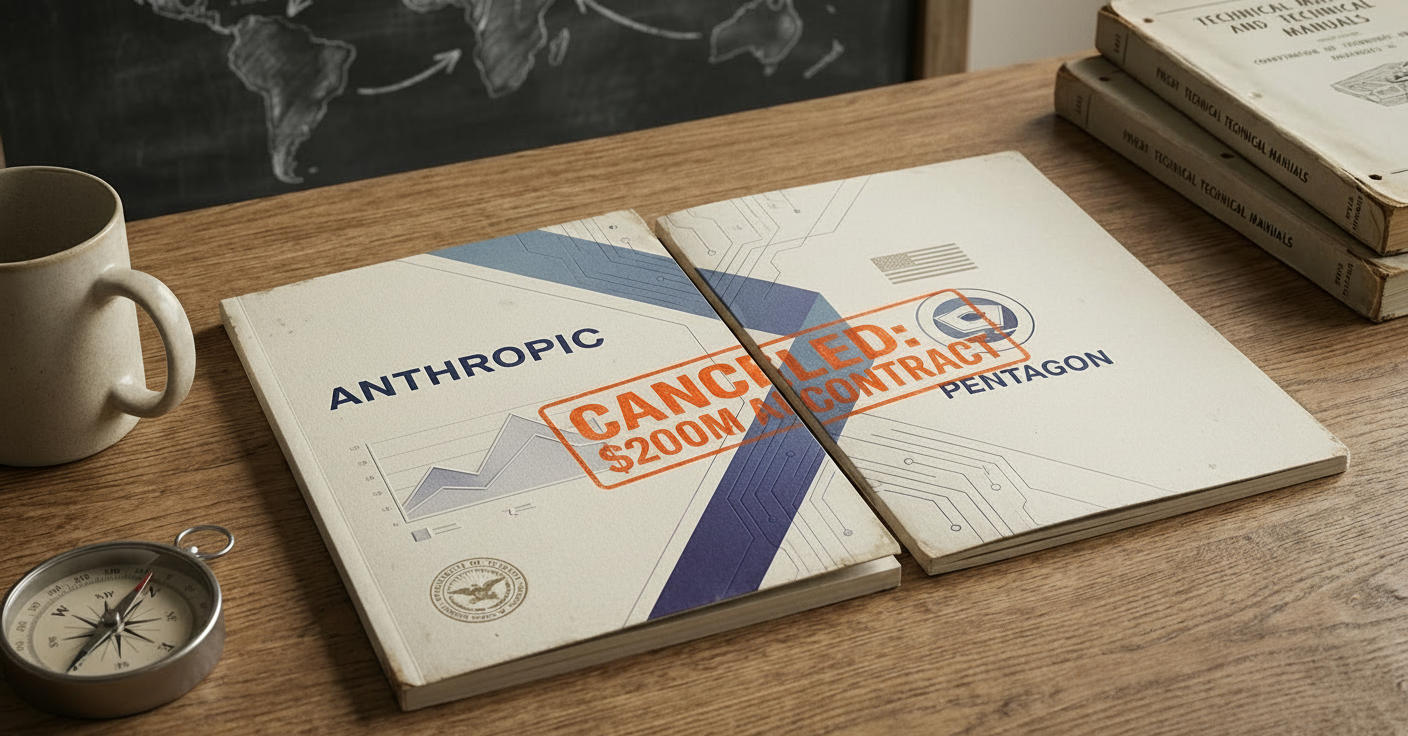
AI's collision with state power is forcing tech giants to pick sides, while the same tech enables lean teams to build $5M pipelines, exposing a widening chasm between the future of work and national interests.
The Intake
📊 11 episodes across 7 podcasts
⏱ 615 minutes of intelligence analyzed
🎙 Featuring: Amelia LeRutte (Chief AI Officer, SaaStr), Jonathan Kvarfordt (VP of GTM, Momentum from Salesforce), Amelia (Chief AI Officer, SaaStr), Aaron Epstein (Host, Y Combinator)
The Big Shift
AI's Geopolitical Gauntlet: When Corporate Morals Meet National Security
The honeymoon phase for AI development is over. This week, conversations crystallized around the direct conflict between the ethical stances of leading AI companies and the demands of nation-states, particularly the US Department of Defense. The spotlight is squarely on Anthropic's principled refusal to allow their AI for autonomous weapons or mass surveillance, leading to a canceled $200 million contract and a "supply chain risk" designation from the Pentagon.
"If AI is as powerful as its builders claim, the people with guns are going to want to say whether that means the US government compelling access, or China deciding to act because America is getting too powerful. These are no longer theoretical questions."
— Ben Thompson, Founder of Stratechery on The a16z Show
The immense capital requirements for building frontier AI models necessitate serving global markets, making government-specific demands economically challenging without private sector breadth (Ben Thompson on The a16z Show). This tension between tech companies' moral compass and their perceived duty to support the US military highlights a fundamental divergence. While OpenAI seems more aligned with public sentiment, Anthropic's stand poses a critical question for the industry: who holds the ultimate power when a technology becomes a matter of national security?
The move: The lines between tech development and geopolitical strategy are blurring. Founders and investors must recognize that the future of AI isn't just about algorithms and data, but also about navigating the complex, often contradictory, demands of state power.
The Rundown
① AI is Redefining 'Lean' for GTM Teams.
SaaStr's Chief AI Officer, 🆕Amelia LeRutte, detailed how 1.5 humans and 20 AI agents generated an additional $4.8 million in pipeline, closing $2.4 million in just eight months. Their multi-agent workflow automates lead enrichment, persona-based content, and follow-up, doubling deal volume and win rate (Amelia LeRutte on The Official SaaStr Podcast: SaaS | Founders | Investors).
→ Why it matters: This is a blueprint for radical go-to-market efficiency, showing how lean AI-powered teams can vastly outperform larger human-only teams, putting pressure on traditional sales and marketing headcounts across the SaaS industry.
② User Experience is Eroding Due to "AI Design Slop".
The ease of AI design tools like LLMs is leading to a proliferation of generic, visually similar "vibe coded" websites featuring distracting animations, inconsistent styles, and poor information hierarchy, which can actively damage brand credibility (Aaron Epstein on Y Combinator Startup Podcast).
→ The signal: While AI automates design, human oversight is more critical than ever to maintain brand originality and ensure user-centricity, as "just because something is easy doesn't mean it's worth doing" (Aaron Epstein on Y Combinator Startup Podcast).
③ The US Lags Globally in AI Adoption Due to Trust Issues.
Despite being an AI innovation hub, the US ranks 20th in per capita AI adoption, primarily due to low public trust (32% favorability) compared to countries like China (80%) and others with higher tech optimism (Olivia Moore on The a16z Show). This highlights a significant cultural and political barrier.
→ What to watch: This distrust creates a unique competitive vulnerability for US tech companies, potentially hindering domestic market growth and allowing other nations to pull ahead in public AI integration.
④ The "SaaS Apocalypse" is Overstated, but Old Models are Toast.
While incumbents with strong distribution, data, and balance sheets will adapt, traditional SaaS models are certainly being disrupted. AI isn't just about efficiency; it's forcing a re-evaluation of software's role from "filing cabinets" to process-driven systems (Mike Cannon-Brookes on The a16z Show). Mitchell Green suggests many "tourist" VCs will exit, and valuations are disconnected from reality for non-AI native companies (Mitchell Green on The Twenty Minute VC (20VC)).
→ The signal: Companies must be AI-first now, with domain differentiation, workflow, and data integration to build defensible moats. The market is increasingly demanding revenue generation from AI products, not just OPEX reduction (Logan Allin on This Week in Startups).
⑤ The Biggest AI Revolution Will Be in Physical Industries.
Qasar Younis, CEO of 🆕Applied Intuition, argues the real impact of AI in the next 5-10 years will be in sectors like farming, mining, construction, and self-driving trucks, which desperately need autonomy due to population decline and aging workforces (Qasar Younis on Lenny's Podcast: Product | Career | Growth).
→ What to watch: Investors should shift focus beyond software and consumer apps to physical AI, where the need is critical and the impact on safety, efficiency, and human lives will be profound, fundamentally changing how essential jobs are done.
Signal Board
🔥 HEATING UP
• AI Agent Orchestration: SaaStr is leveraging 🆕Zapier with tools like 🆕Momentum (from Salesforce) to effectively manage 20 AI agents for GTM, pushing data back into Salesforce and doubling win rates. (Amelia LeRutte on The Official SaaStr Podcast: SaaS | Founders | Investors)
• Autonomous AI for Industries: The future of AI's biggest impact lies in physical industries like farming, mining, construction, and self-driving trucks, not just software. (Qasar Younis on Lenny's Podcast: Product | Career | Growth)
• AI for Workflow Augmentation: Atlassian is integrating AI into Jira for summarizing service tickets, enhancing existing workflows rather than replacing them. (Mike Cannon-Brookes on The a16z Show)
👀 ON WATCH
• AI Design Challenges for User Trust and Experience 🆕: The growing trend of "AI design slop" with purple gradients and distracting animations indicates a critical need for human-led, opinionated design decisions for credibility. (Aaron Epstein on Y Combinator Startup Podcast)
• Anthropic vs. Pentagon dispute over AI usage 🆕: Anthropic's stance against military use of AI has led to contract cancellations and designation as a supply chain risk, highlighting the complex collision of tech ethics and state power. (Rory O'Driscoll on The Twenty Minute VC (20VC))
• Software Pricing Evolution in the AI Era 🆕: Traditional fixed subscriptions are giving way to consumption-based models, but predictability challenges in accounting for usage-based revenue remains a key issue for sales teams. (Mike Cannon-Brookes on The a16z Show)
🧊 COOLING OFF
• SaaS Apocalypse Narrative: Many incumbent SaaS companies will still thrive due to existing distribution, data, and balance sheets, refuting blanket predictions of their demise. (Mitchell Green on The Twenty Minute VC (20VC))
• Generic AI-Generated Designs: The overuse of common AI aesthetic patterns like purple gradients is leading to a lack of originality and actively damaging brand credibility. (Raphael Schaad on Y Combinator Startup Podcast)
• US AI Adoption: The US lags globally in per capita AI adoption (20th place) primarily due to significant public distrust in AI, unlike countries with higher tech optimism. (Olivia Moore on The a16z Show)
The Debate
The venture ecosystem is divided on the future of AI leadership between the US and China.
🐂 The bull case for China: Mitchell Green of Lead Edge Capital firmly believes China will "win the AI world," citing their ingenuity, infrastructure capabilities (like quickly building nuclear power plants for energy-intensive AI), and the state-driven nature of companies which allows for rapid, coordinated development, with ByteDance being a key player. (Mitchell Green on The Twenty Minute VC (20VC))
🐻 The bear case for comparing Chinese companies to Western ones: Qasar Younis, Co-founder and CEO of 🆕Applied Intuition, asserts that comparing Chinese companies like Huawei to Western counterparts is fundamentally flawed because Chinese entities function as extensions of the state with goals beyond profit. This makes direct comparisons misleading and their motivations inscrutable by Western market logic (Qasar Younis on Lenny's Podcast: Product | Career | Growth).
Our read: While direct comparisons of "companies" might be flawed due to differing operating models, the shared conviction across both nuanced views is that China is an AI force to be reckoned with, and underestimating them is a strategic error.
The Bottom Line
The AI battle lines are drawn—between ethics and defense, human creativity and AI "slop," and US distrust versus China's state-driven ambition—forcing every tech company to navigate an increasingly complex geopolitical and cultural landscape.
Your Move
1. Assess your GTM efficiency: Can your sales and marketing team achieve a SaaStr-level efficiency leap (e.g., $4.8M pipeline with 1.5 humans, 20 AI agents)? Map out current processes and identify 3-5 tasks for immediate agent automation, aiming for an ROI within 90 days.
2. Audit your brand for "AI Design Slop": Have AI tools inadvertently led to generic design elements (e.g., ubiquitous purple gradients, distracting animations) on your website or product? Task your design lead with a critical review, emphasizing human-led originality and usability over easy AI-generated aesthetics.
3. Evaluate AI's physical industry potential: For your portfolio, are you underestimating AI's impact beyond software? Challenge your team to identify opportunities in "offline" sectors like manufacturing, logistics, or field services where automation could address labor shortages or safety issues, akin to its impact on mining or farming.
📖 Want the full episode breakdowns, guest details, and listen links?
Quick appendix
The a16z Show: "Ben Thompson: Anthropic, the Pentagon, and the Limits of Private Power" · 37 min · Featuring Ben Thompson
For the Stretched CEO: Listen to understand the unavoidable collision between AI power and state power, and how public perception shapes the future of government contracts for AI companies.
The a16z Show: "Atlassian CEO on the SaaS Apocalypse, AI Agents & What Comes Next" · 55 min · Featuring Mike Cannon-Brookes
For the Stretched CEO: Listen for an insider's take on how AI is reshaping SaaS pricing, product development (especially human-agent collaboration), and the future of enterprise software.
The a16z Show: "The Top 100 Gen AI Consumer Apps" · 41 min · Featuring Anish Acharya
For the Stretched CEO: Listen to grasp global AI adoption trends, the surprising dominance of ChatGPT, and the emerging landscape of AI agents and creative tools, especially among younger demographics.
The Official SaaStr Podcast: SaaS | Founders | Investors: "SaaStr 845: How SaaStr Built a $5 million Pipeline Machine with 1.5 Humans and 20 AI Agents with SaaStr's Chief AI Officer and Momentum from Salesforce's VP of GTM" · 41 min · Featuring Amelia LeRutte
For the Stretched CEO: Listen if you're serious about leveraging AI agents for GTM, as this provides a concrete case study on dramatically increasing pipeline and win rates with a lean team.
Equity: "Anthropic vs. the Pentagon, the SaaSpocalypse, and why competition is good, actually" · 35 min · Featuring Kirsten Korosec
For the Stretched CEO: This episode dissects the Anthropic-Pentagon dispute and its implications for startups pursuing federal contracts, alongside a nuanced take on the "SaaS Apocalypse" and AI's competitive forcing function.
Lenny's Podcast: Product | Career | Growth: "The most successful AI company you’ve never heard of | Qasar Younis" · 84 min · Featuring Qasar Younis
For the Stretched CEO: Listen for a contrarian, pragmatic view on AI's real-world impact beyond software, particularly in physical industries, and how to approach building quietly for deep product focus.
This Week in Startups: "How agents will change banking forever | E2260" · 61 min · Featuring Jason Calacanis
For the Stretched CEO: Tune in for a look at AI self-improvement, the contrasting public perception of AI in the US vs. China, and the strategic importance of managing AI or pursuing robot-proof trades.
This Week in Startups: "Is Anthropic Making the Biggest Mistake in AI History | E2258" · 81 min · Featuring Jason Calacanis
For the Stretched CEO: This episode provides critical insight into Anthropic's revenue growth and CEO Dario Amodei's principled stance against military use, offering differing perspectives on the high-stakes decision.
The Twenty Minute VC (20VC): Venture Capital | Startup Funding | The Pitch: "20VC: Anthropic vs The Pentagon: Who Wins | OpenAI's $110BN Mega Round | Cursor Hits $2BN in ARR | Block's 40% Headcount Reduction: AI or Overhiring" · 83 min · Featuring Harry Stebbings
For the Stretched CEO: This is a must-listen for understanding the Anthropic vs. Pentagon dispute, the scale of OpenAI's funding, and the debate around headcount reductions in the age of AI.
The Twenty Minute VC (20VC): Venture Capital | Startup Funding | The Pitch: "20VC: Why the SaaS Apocalypse is BS | Why China Will Win the AI War | Why 50% of VCs Should Not Exist and are Tourists | Why Stock-Based Comp is the Hidden Sin of the Valley with Mitchell Green, Lead Edge Capital" · 60 min · Featuring Mitchell Green
For the Stretched CEO: Listen for a blunt take on why the SaaS apocalypse is overblown for resilient companies, why China is poised to win the AI war, and the overlooked issue of stock-based compensation.
Y Combinator Startup Podcast: "How To Avoid AI Design Slop" · 37 min · Featuring Aaron Epstein
For the Stretched CEO: Essential for anyone leveraging AI in design, this episode offers crucial insights on preventing generic "AI design slop" and maintaining brand originality and user experience.