
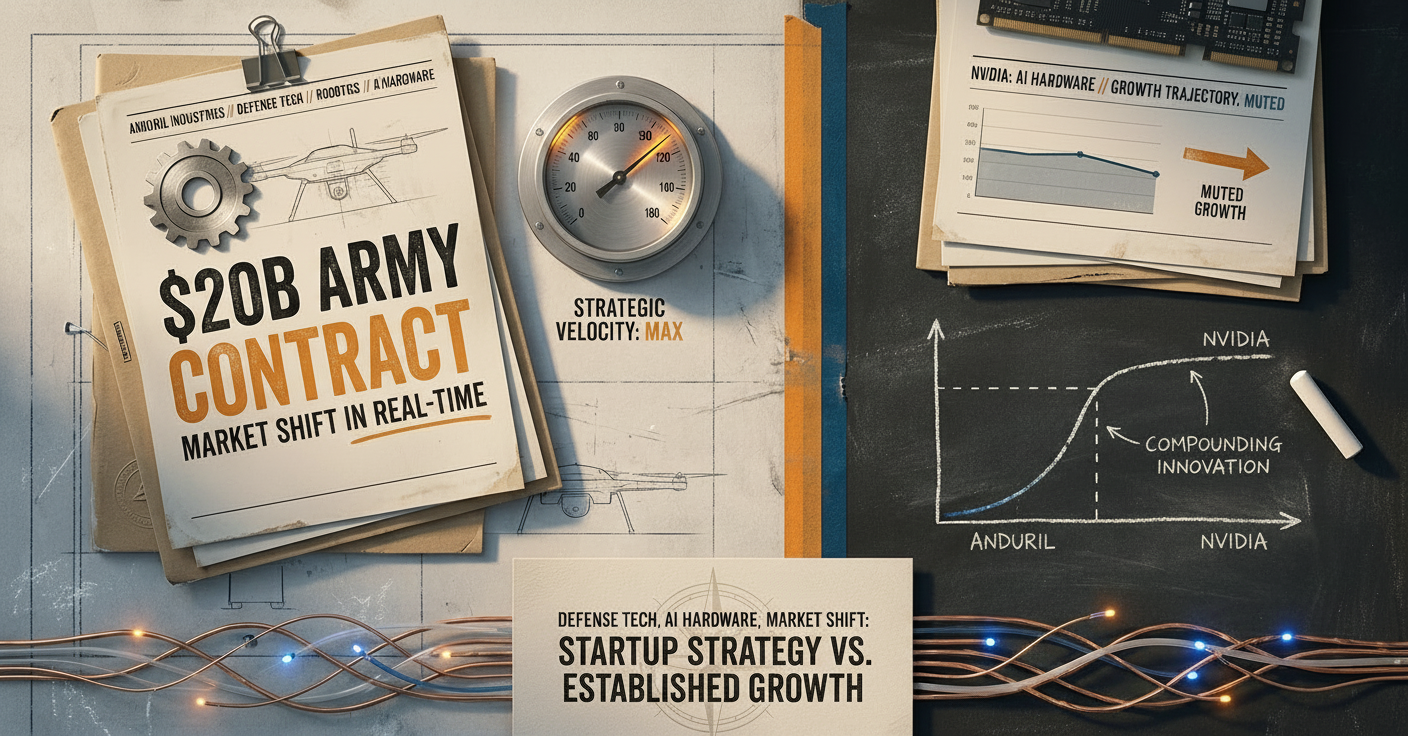
The smartest money is quietly repositioning into defense tech and physical goods, where AI creates new competitive moats, not just software features.
The Intake
📊 11 episodes across 8 podcasts
⏱ 735 minutes of intelligence analyzed
🎙 Featuring: Keller Cliffton (Zipline), Jason Calacanis (This Week in Startups), Keller Rinaudo Cliffton (Zipline), Raul Vora (Superhuman)
The Big Shift
The New Defensibility: Physical Robotics and Defense Tech
The market's narrative is shifting rapidly, moving beyond pure software plays to embrace the tangible, particularly in robotics and defense technology. Anduril's massive $20 billion Army contract and Zipline's surprising success in mass-market drone delivery signal a new era where physical infrastructure, enabled by advanced AI, generates unprecedented defensibility and impact. This isn't just about AI improving existing processes; it's about AI making previously impossible physical solutions not only viable but dominant.
Matthew Steckman, President of Anduril, highlighted the critical insight required for success in defense: "In every technology class in defense, there's probably one, sometimes two actual programs that if you capture them, you have a Business. And if you don't, you have no business." This "winner-take-all" dynamic suggests enormous leverage for companies that can effectively blend deep domain knowledge with cutting-edge tech. Anduril's strategy of building cruise missile airframes using "bathtub manufacturing" for scalability, for example, is a material innovation that trumps mere software enhancements. (Matthew Steckman on The Twenty Minute VC)
"We felt like robotics would allow us to build a new kind of logistics system that could be 10 times as fast, half the cost. Zero emission logistics really only serves the golden billion people on earth well."
— Keller Cliffton, Founder of Zipline on This Week in Startups
Similarly, Zipline's journey, from regulatory hurdles in Rwanda to achieving a 51% reduction in maternal mortality and now dominating suburban delivery for major partners like Walmart and Chipotle, exemplifies the power of hardware-enabled networks. Keller Cliffton revealed that "We now have Zipline more than 50% of all deliveries from that Wendy's. So all the other platforms combined are less than 50%. Zipline is more than 50%." (Keller Cliffton on This Week in Startups). This market dominance in last-mile delivery, especially for suburban and non-tech-savvy demographics, highlights that physical systems with AI at their core are solving real-world, high-value problems that software-only solutions can't touch. The smart money is not just looking for AI, but for AI that moves atoms, not just bits, creating durable, often monopolistic positions.
The Move: Look for physical products and services that leverage AI to create a new category or achieve extreme efficiency, especially in sectors with high barriers to entry like defense, logistics, or infrastructure. The defensibility here is multifaceted: regulatory, operational, and technological.
The Rundown
① Market Muted on NVIDIA's AI Dominance.
Despite NVIDIA’s projected $1 trillion in cumulative demand for AI chips, the market reaction was surprisingly subdued, suggesting much of this growth was already priced into the stock. Rory O'Driscoll noted that "The sound bite was half a trillion dollars of demand over the next two years... And now the sound bite is a trillion dollars in demand. But if you listen carefully, it includes 27." (Rory O'Driscoll on The Twenty Minute VC)
→ The signal: The "AI is hot" narrative is maturing; truly novel information is getting harder to find and value. Future outperformance will depend on specific, often contrarian, insights beyond headline growth numbers.
② Layoffs are a Strategic AI Re-skilling, Not Just Cost-Cutting.
Current layoffs at profitable companies like Atlassian and Meta aren't just about financial optimization, but a purposeful re-engineering of the workforce towards AI-fluent talent. Jason Lemkin explained, "Everyone's looking at the teams they have and saying, I just don't know what to do with half of the... I don't need half of these people. I don't need them. I do need people. I need different people." (Jason Lemkin on The Twenty Minute VC)
→ What to watch: Companies are reallocating capital and talent toward individuals who can practically implement and evaluate AI tools. Look for hiring trends emphasizing 'AI Fluency' 🆕 and 'agent deploy expertise' over theoretical knowledge.
③ Influence, Not AI, is the Un-Replaceable Skill.
In an AI-driven world, the ability to influence others, especially executives, is becoming the single most critical and AI-resistant skill for product leaders. Jessica Fain highlighted that "It's your fault if the leaders didn't buy into your idea. Like, it's not, you can't just be like, ah, they never, they just don't see it. It's not my fault. They, they agreed to do something else." (Jessica Fain on Lenny's Podcast)
→ Why it matters: As AI automates more execution, the premium shifts to the human ability to shape strategy, garner buy-in, and drive outcomes. This skill is a fundamental differentiator in senior roles.
④ The Rise of the "AI Sandwich" Firm Model.
Future firms might adopt an "AI sandwich" structure, where a human director guides AI agents performing long-running tasks, and a small team of top human verifiers ensures quality. Christian Catalini noted, "AI agents can now perform long running tasks... this sensation is very similar to the sensation of working with somebody." (Christian Catalini on The a16z Show)
→ The signal: This model implies a dramatic restructuring of organizational charts, with fewer mid-level human workers and a higher demand for both high-level strategists and meticulous quality assurance specialists.
⑤ Silicon Valley's "Hacker Culture" Blurs Ethical Lines.
The Delve scandal, where a compliance startup allegedly oversold capabilities and committed fraud, highlights how the "hacker culture" can lead founders to cross the line from exaggeration to outright fraud. Ryan Mahdavi stated, "These are very serious allegations which if proven will likely have criminal implications." (Ryan Mahdavi on This Week in Startups)
→ What to watch: Due diligence needs a renewed focus on verifying fundamental claims, especially for "diligence by proxy" angel rounds, as the line between innovative disruption and deceptive practice becomes increasingly thin.
Signal Board
🚀 Heating Up
• Anduril: Securing a $20 billion Army contract, highlighting the massive capital opportunities for companies that blend defense domain expertise with advanced tech. (Matthew Steckman on The Twenty Minute VC)
• Zipline: Achieving significant market penetration in US suburban delivery and a 95 NPS, demonstrating the viability of hardware-based drone logistics. (Keller Cliffton on This Week in Startups)
• Robinhood: Proving the long-term success of its user-acquisition-first strategy, now boasting 11 lines of business each generating over $100M annually. (Vlad Tenev on This Week in Startups)
👀 On Watch
• AI Regulation 🆕: Growing fragmentation across states while federal efforts lag, portending complex compliance challenges for tech companies. (Scott Galloway on Pivot)
• Delve 🆕: A compliance startup at the center of a scandal for allegedly overselling capabilities and fraud, highlighting venture diligence pitfalls. (Jason Calacanis on This Week in Startups)
• First Principles Thinking 🆕: Emphasized by Elon Musk as a core method for solving tough problems and eliminating unnecessary complexity in engineering. (David on Founders)
• Bittensor 🆕: A decentralized network enabling anonymous, global competition for tasks like lead generation, dramatically lowering costs and increasing quality. (Gavin Zainz on This Week in Startups)
🧊 Cooling Off
• Humanoid robots: Travis Kalanick's Atoms is focusing on wheeled robots over humanoids for industrial efficiency, citing power consumption and instability issues. (Harry Stebbings on The Twenty Minute VC)
• NVIDIA's OpenClaw strategy: While aiming to hedge against future AI shifts, its sustainability is questioned as market shifts or declines could diminish its importance. (Rebecca Bellan on Equity)
The Debate
Is Travis Kalanick's return indicative of Uber's lost potential?
There's a fascinating split view on Travis Kalanick's departure from Uber and his subsequent return to the robotics space with Atoms.
🐂 The bull case: Some argue that with Kalanick at the helm, Uber would have achieved a $1 trillion valuation by now, suggesting his aggressive vision was curtailed too soon. Harry Stebbings and Jason Lemkin debated the "Travis Kalanick for a trillion-dollar Uber" hypothesis, implying that founders' unapologetic vision often precedes immense growth. (Harry Stebbings on The Twenty Minute VC)
🐻 The bear case: Others point to Kalanick's controversial management style and allegations of a hostile work environment persisting even at Cloud Kitchens, suggesting his vision came at too high a cost. Sean O'Kane explicitly stated, "There is... an unwillingness among the people like that to engage with the reasons that Travis was pushed out of Uber...problems that were coming up at Uber...persisted at Cloud Kitchens. There were allegations of harassment from the executives there...it was a hostile work environment." (Sean O'Kane on Equity)
Our read: While Kalanick's vision for Uber is undeniably bold and disruptive, the consistent pattern of controversial workplace cultures undermines the "trillion-dollar Uber" narrative, highlighting that financial success, while critical, doesn't always justify the human cost or insulate from scrutiny.
The Bottom Line
The smart money isn't just funding AI; it's funding AI that builds physical moats, while traditional software plays are tightening their belts and re-skilling for a more agentic future.
📖 Want the full episode breakdowns, guest details, and listen links?
Episode Guide (Web Version Excerpt)
Here's a curated list of the full episodes our Intelligence Team listened to this week. We've highlighted key takeaways and guests to help you prioritize.
The Twenty Minute VC (20VC): Venture Capital | Startup Funding | The Pitch — "20VC: Inside Anduril's $20BN Army Contract & Why Anduril Must Go Public | Why 99% of Drone Companies Will Die | Why There is Never an Ethical Question of How Anduril Products are Used with Matthew Steckman, President @ Anduril"
Runtime: 54 min | Host: Harry Stebbings (Host, The Twenty Minute VC) | Guest: Matthew Steckman (President and Chief Business Officer, Anduril)
Who should listen: Founders and investors in defense tech, hardware innovation, or government contracting looking for insights into winning large-scale programs and navigating ethical considerations.
Matthew Steckman, President of Anduril, offers a masterclass on defense tech, discussing their recent $20B contract and the unique blend of insider knowledge and outside tech needed for success. He also delves into the critical role of innovative manufacturing in missile systems.
"You basically can't have a defense company if you don't have a large US business, right? So 50% of defense spending is in the US and 50% is in the rest of the world."
— Matthew Steckman, President and Chief Business Officer of Anduril
This Week in Startups — "The Drone Company Everyone Thought Was Illegal (Now Worth $4B+) | E2265"
Runtime: 99 min | Host: Jason Calacanis (Host, This Week in Startups) | Guest: Keller Cliffton (Founder, Zipline)
Who should listen: Founders and VCs interested in hardware startups, disruptive logistics, and market penetration strategies, especially in complex regulatory environments.
Keller Cliffton, Zipline founder, shares the incredible story of building a drone delivery empire from Rwanda to the US, achieving massive social impact and commercial success despite early skepticism. He also reveals the surprising demographics of their users.
"We now have Zipline more than 50% of all deliveries from that Wendy's. So all the other platforms combined are less than 50%. Zipline is more than 50%."
— Keller Cliffton, Founder of Zipline
This Week in Startups — "How Robinhood became a $68B company w/ Vlad Tenev"
Runtime: 50 min | Host: Jason Calacanis (Host, This Week in Startups) | Guest: Vlad Tenev (Founder, Robinhood)
Who should listen: Fintech founders, product leaders, and growth marketers exploring how to achieve massive scale and multi-product success, even with intense scrutiny.
Vlad Tenev unpacks Robinhood's journey to a $68B valuation, emphasizing their user acquisition-first strategy and how they overcame initial investor skepticism. He details their growth by eliminating commissions and achieving high AI-handled customer support interactions.
"If you look at the commission brokers before they failed or got folded into bigger players... they made on average $11 for every time a customer placed a trade. $10 of that was the commission they charged to the customer. $1 roughly was the payment for order flow rebate."
— Vlad Tenev, Founder, Robinhood
Equity — "Nvidia has an OpenClaw strategy. Do you?"
Runtime: 38 min | Host: Rebecca Bellan (Host, TechCrunch)
Who should listen: Investors and strategists analyzing the competitive landscape in AI, robotics, and autonomous vehicles, with a focus on big tech strategies.
This episode dissects NVIDIA's "OpenClaw" strategy, Travis Kalanick's new robotics venture, and Uber's partnership with Rivian for autonomous R2 SUVs. It offers a critical look at the challenges and financial implications of these ambitious tech plays.
"Rivian's lost 27 billion to date, billion since its inception. And so they had really been looking at this... as a moment where they would jump from just kind of like gross profit on their vehicles to at least positive ebitda."
— Sean O'Kane, Senior Reporter and Host at TechCrunch
My First Million — "This guy cured his dog’s cancer with ChatGPT + 4 other crazy AI stories"
Runtime: 54 min | Host: Sam Parr (Host, My First Million) | Guest: Nat Friedman (Founder, Alpha School)
Who should listen: Entrepreneurs and innovators looking for surprising applications of AI, new business models, and contrarian approaches to education and wealth creation.
Shaan Puri and Sam Parr share viral AI stories, including a dog's cancer cure via ChatGPT, Anthropic's staggering revenue, and Alpha School's incentive-aligned education model. They also explore how AI creates "business in a box" opportunities.
"Anthropic did $6 billion in revenue in a single month, last month. That's more revenue than Snowflake or Databricks, two of the greatest software companies of the last 20 years."
— Shaan Puri, Host of My First Million
Founders — "#415 How Elon Thinks"
Runtime: 51 min | Host: David (Host, Founders) | Guest: Eric Jorgenson (Author of The Book of Elon, Self-employed)
Who should listen: Founders, leaders, and anyone interested in the management philosophy of Elon Musk, focusing on his unconventional approach to engineering, leadership, and problem-solving.
Drawing from "The Book of Elon," this episode explores Musk's philosophy on leadership, product development, and company building, emphasizing first principles thinking, brutal honesty, and a maniacal focus on efficiency and speed.
"Physics does not care about hurt feelings. It cares about whether you got the rocket right. All bad news should be given loudly and often. Good news can be said quietly and once."
— Elon Musk, CEO of Tesla & SpaceX (quoted)
Lenny's Podcast: Product | Career | Growth — "The art of influence: The single most important skill that AI can’t replace | Jessica Fain (Webflow, ex-Slack)"
Runtime: 94 min | Host: Lenny Rachitsky (Host) | Guest: Jessica Fain (Product Leader, Webflow)
Who should listen: Product managers, leaders, and anyone looking to enhance their executive communication and influence skills in an increasingly AI-centric professional landscape.
Jessica Fain discusses why influence is paramount for product leaders, especially with executives, detailing actionable strategies for setting context, asking "spicier" questions, and co-creating solutions to build trust and drive impactful decisions.
"It's your fault if the leaders didn't buy into your idea. Like, it's not, you can't just be like, ah, they never, they just don't see it. It's not my fault. They, they agreed to do something else."
— Lenny Rachitsky, Host of Lenny's Podcast