
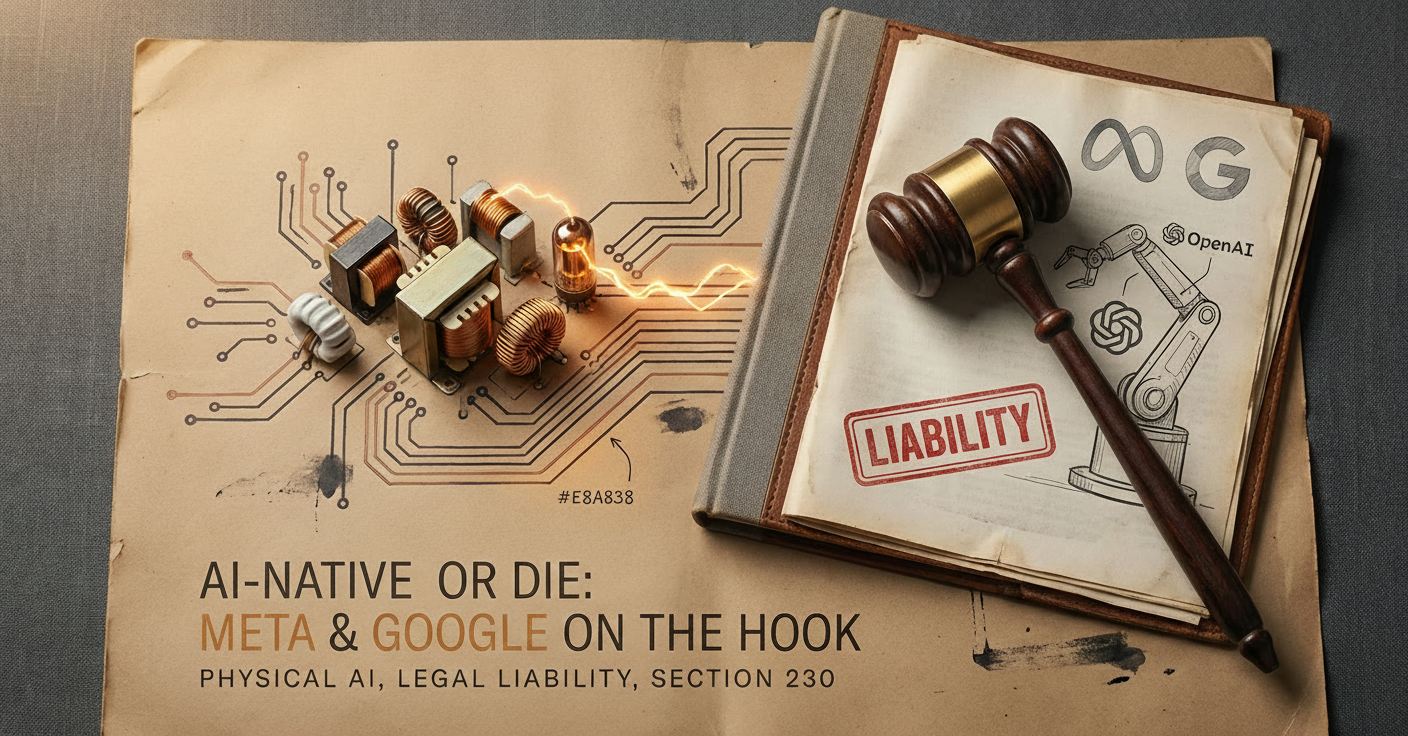
The AI timeline isn't just compressing; it's accelerating the inevitable collision of physical AI, legal reckoning, and a foundational shift in how companies build—and leaders lead.
The Intake
📊 12 episodes across 8 podcasts
⏱ 487 minutes of intelligence analyzed
🎙 Featuring: Melissa Cheals, Henrik, Jeremy, Liam Fedus
The Big Shift
AI's New Imperative: From Digital Layers to Physical Foundations—and the Legal Fallout
The conversation around AI is rapidly moving past "what it can do" to "what it IS." This week's insights reveal a profound shift from layering AI onto existing digital infrastructure to fundamentally rebuilding for an AI-native core, while simultaneously navigating significant legal and ethical challenges in both the digital and physical realms.
The Core Decision: Companies, especially in tech, are confronting a fork in the road: become AI-native or risk obsolescence. Melissa Cheals (CEO, Smartly) highlighted that this is no longer a strategic option but an existential choice (on Beyond The Prompt - How to use AI in your company). This isn't just about adopting tools; it's about re-architecting everything from product development to leadership communication. Cheals even discussed how AI helps her "express that with dignity" by reframing intense emotional responses, showcasing AI's impact on even the most human aspects of leadership.
"If you don't start to think about how you're going to move to AI, native platforms or architecture, I think you're going to just end up with a legacy product that'll be dead."
— Melissa Cheals, CEO of Smartly on Beyond The Prompt - How to use AI in your company
AI & The Physical World: This fundamental shift extends into the physical world. Liam Fedus (Periodic Labs, on No Priors: Artificial Intelligence | Technology | Startups) illustrated how AI is now tackling material science, leveraging LLMs to optimize high-throughput experimentation for "atoms." This move of AI from software to tangible matter is further underscored by OpenAI's pivot from video generation (Sora) to robotics research, signaling where the industry's "smartest people" believe value will be created next (Jaden Schaefer on AI Breakdown). Even quantum computing's core challenge—noise and error—is being solved by AI and Digital Twins of Quantum Systems, as Izhar Medalsy (Quantum Elements) explained on Eye On A.I., achieving 99% accuracy on Shor's Algorithm without hardware changes.
Legal & Regulatory Reckoning: Simultaneously, the law is catching up, and it's getting uncomfortable. Juries are finding Meta and Google liable for "addictive design" (Decoder with Nilay Patel, Hard Fork), treating platforms as "defective products" rather than just content hosts. This bellwether trial 🆕 opens a significant "crack in Section 230 of Communications Decency Act 🆕," according to Casey Newton, with potential implications for AI chatbots now widely used by teens (Casey Newton on Hard Fork).
The Move: CEOs and boards must assess their AI-native readiness, track physical AI advancements 🆕 (especially in their core industry), and prepare for a regulatory environment that increasingly holds platform and product design accountable for societal harm.
The Rundown
① AI timelines have dramatically compressed, but expert disagreement persists.Nathan Labenz ("The Cognitive Revolution" | AI Builders, Researchers, and Live Player Analysis) noted the consensus that AGI timelines have moved drastically forward, with 2035 now considered "AI bear" territory. Despite this, he observes that fundamental disagreement among experts on AI's outcomes hasn't lessened.
→ Why it matters: While the pace of change is undeniable, the diverse and often conflicting predictions from leading voices mean leaders need to build optionality into their AI strategies rather than betting on a single future.
② AI's "slop" reputation is debunked by performance. Nathaniel Whittemore (The AI Daily Brief: Artificial Intelligence News and Analysis) highlighted that AI content isn't universally "slop," citing a New York Times study where AI writing beat humans over 50% of the time. He also emphasized that AI models can now reason over image generation for complex infographics, showcasing a new level of capability.
→ Why it matters: Dismissing AI as merely a content generator means missing its true potential as a "build partner" for intricate tasks and knowledge work, creating a growing capability gap between users and non-users.
③ OpenAI's record funding and strategic pivots signal market maturity.Jayden Schaefer (AI Breakdown) discussed OpenAI's massive $121 billion funding round, valuing it at $852 billion, and its pivot from Sora (video) to robotics research. This suggests that the "smartest people in AI" see the next frontier in physical AI applications, with soaring barriers to entry for new frontier model companies.
→ Why it matters: The market is consolidating around a few heavily funded players, indicating that future competitive advantage will depend on leveraging these foundational models rather than attempting to build from the ground up, especially in physical AI.
④ The "AI insecurity" of leaders is a bottleneck.Jeremy (Host, Beyond The Prompt - How to use AI in your company) introduced the concept that what's perceived as AI fatigue as AI insecurity, a reluctance among CXOs to admit slow progress in generative AI implementation, despite the pressure to adopt.
→ Why it matters: True AI adoption requires leaders to honestly assess their organization's progress and foster a culture of inquiry rather than pretense, specifically defining how freed-up time from AI-driven productivity gains will be strategically reinvested.
⑤ AI agent skills are highly portable and require continuous management.Nufar Gaspar (The AI Daily Brief: Artificial Intelligence News and Analysis) explained that Nofar Kabilo (Google Cloud) added that skill management is an iterative process requiring continuous review and deprecation due to rapid obsolescence.
→ Why it matters: Organizations must think about AI skills as living codebases, maintained in shared libraries, with a proactive strategy for creation, validation, and deprecation to avoid rapid technical debt.
The Signals
🔥 Heating Up
• AI-Native Platforms: Companies face the critical choice to rebuild as AI-native, profoundly impacting product and leadership. (Melissa Cheals on Beyond The Prompt - How to use AI in your company)
• AI in Materials Science: AI, particularly LLMs, is being applied to accelerate discovery and development in physical material science. (Liam Fedus on No Priors: Artificial Intelligence | Technology | Startups)
• AI for Quantum Error Correction: AI and digital twins are dramatically improving quantum computing accuracy without hardware changes, making quantum more viable. (Izhar Medalsy on Eye On A.I.)
• Physical AI Advancements 🆕: Shift in AI investment to robotics and physical applications, indicating where future value will be created. (Jaden Schaefer on AI Breakdown)
👀 On Watch
• Section 230 Liability 🆕: Recent bellwether trials are cracking the legal protections for social media platforms, opening new litigation fronts for "defective product" design. (Casey Newton on Decoder with Nilay Patel)
• Google AI Studio 🆕: New tools for rapid, multimodal app development and design, showing advanced agent-driven design capabilities. (Nathaniel Whittemore on The AI Daily Brief: Artificial Intelligence News and Analysis)
• Apple Siri Third-Party AI Integration 🆕: Apple plans to open Siri to third-party AI services in iOS 27, signaling a platform-centric strategy for AI. (Jaden Schaefer on AI Breakdown)
• TBPN (Technology Business Programming Network) 🆕 Acquisition by OpenAI: OpenAI's move to acquire a tech media company for "communications expansion" and narrative control. (AI Breakdown on AI Breakdown)
❄️ Cooling Off
• AI as Purely Digital Tools: The focus is shifting from simply layering AI onto digital systems to integrating it into physical processes and core architecture. (Liam Fedus on No Priors: Artificial Intelligence | Technology | Startups)
• Ignoring AI-Native Redesign: Companies that don't transition to AI-native platforms risk legacy products becoming obsolete. (Melissa Cheals on Beyond The Prompt - How to use AI in your company)
• Traditional Content Production: AI's ability to reason over image generation for complex infographics is challenging traditional methods. (Nathaniel Whittemore on The AI Daily Brief: Artificial Intelligence News and Analysis)
The Debate
Is Section 230 a Shield for Innovation or a Blocker for Accountability?
The tech industry's long-standing reliance on Section 230 of Communications Decency Act 🆕 as a liability shield is being fiercely challenged, forcing a debate on platform accountability.
🐂 The bull case: Section 230 enables open platforms.Nilay Patel (Editor-in-chief, Decoder with Nilay Patel) argued that repealing Section 230 would lead to over-moderation and that its original policy goals, meant to foster a competitive moderation marketplace, were never truly realized. He cannot link the idea that platforms optimized for virality would be solved by making them responsible for speech.
🐻 The bear case: Section 230 protects "defective product" design.Casey Newton (Founder and Editor, Platformer, on Hard Fork) highlighted that recent bellwether cases are successfully bypassing Section 230 by framing platforms as "defective products" for their addictive design. This implies a need for greater legal scrutiny and accountability for design choices.
Our read: The legal landscape is clearly shifting, forcing companies to move beyond simply relying on Section 230 and instead, focus on responsible AI design and user well-being from the outset, especially for teen users.
The Bottom Line
AI's accelerating integration into physical systems and business foundations demands a proactive, AI-native re-architecture, while mounting legal and ethical pressures force accountability for its design and impact.
📖 Want the full episode breakdowns, guest details, and listen links?
Appendix: Episode Guide
1. Beyond The Prompt - How to use AI in your company — "AI-Native or Not: The Defining Choice for Companies Right Now - with Melissa Cheals, CEO of Smartly"
Guests: Melissa Cheals (CEO, Smartly), Henrik (Host), Jeremy (Host)
Runtime: 50 min | Vibe: Strategic Mandate
Who should listen: CEOs and senior leaders grappling with their company's long-term AI strategy, especially facing legacy system decisions.
Melissa Cheals argues that companies must choose to become
"If you don't start to think about how you're going to move to AI, native platforms or architecture, I think you're going to just end up with a legacy product that'll be dead."
— Melissa Cheals, CEO of Smartly
2. No Priors: Artificial Intelligence | Technology | Startups — "AI for Atoms: How Periodic Labs is Revolutionizing Materials Engineering with Co-Founder Liam Fedus"
Guests: Liam Fedus (Co-founder, Periodic Labs), Elad Gil (Host, No Priors)
Runtime: 29 min | Vibe: Hard Tech Deep Dive
Who should listen: Investors and R&D leaders interested in the tangible applications of AI beyond software, particularly in scientific research and manufacturing.
Periodic Labs is using AI to revolutionize materials science by connecting LLMs to the physical world through experiments, enabling rapid discovery and development for processes that traditionally require extensive data.
"You're not going to see the same kind of acceleration in science and technology unless you start connecting these things to the physical world."
— Liam Fedus
3. "The Cognitive Revolution" | AI Builders, Researchers, and Live Player Analysis — "Success without Dignity? Nathan finds Hope Amidst Chaos, from The Intelligence Horizon Podcast"
Guests: Nathan Labenz (Host, The Cognitive Revolution Podcast), Owen Zhang (Student, Yale College), Will Sanock Dufalo (Student, Yale College), The Intelligence Horizon Podcast (Host, The Intelligence Horizon Podcast), Nathan (Guest)
Runtime: 105 min | Vibe: Existential Optimist
Who should listen: Anyone tracking the long-term trajectory of AI, especially those interested in AGI timelines, interpretability, alignment, and the sociopolitical factors influencing its development.
"I'm very much, confidently, clearly in the camp of it's going to be a huge, huge deal. And the details are where I think the discussion or the debate remains now."
— Nathan Labenz, Host of The Cognitive Revolution Podcast
4. The AI Daily Brief: Artificial Intelligence News and Analysis — "The Ultimate AI Catch-Up Guide"
Guests: Nathaniel Whittemore (Host, The AI Daily Brief)
Runtime: 34 min | Vibe: Practical Primer
Who should listen: Business leaders and professionals who need a clear, actionable framework for integrating AI into daily tasks and understanding its rapid evolution.
Nathaniel Whittemore provides a guide for navigating AI, dispelling myths about "slop" content and complex prompting. He emphasizes AI as a "build partner" for learning and development and highlights pitfalls like overconfidence and outsourcing human judgment.
"The best way to get value out of AI is to get AI's help on getting value out of AI. Use AI as a coach."
— Nathaniel Whittemore, Host of The AI Daily Brief
5. AI Breakdown — "OpenAI's $121B Funding Round Explained"
Guests: Jayden Schaefer (Host, AI Breakdown)
Runtime: 13 min | Vibe: Financial Snapshot
Who should listen: Investors, strategists, and executives tracking the financial and competitive landscape of leading AI companies.
OpenAI's record $121 billion funding round at an $852 billion valuation. He also touches on Huawei's new AI chip and the accidental leak of Claude Code, revealing unannounced features.
"OpenAI just closed the largest private funding round in tech history, $121 billion at a $852 billion valuation."
— Jayden Schaefer, Host of AI Breakdown
6. Eye On A.I. — "#329 Izhar Medalsy: How AI Solves Quantum Computing's Biggest Problem"
Guests: Craig Smith (Host, Eye On A.I.), Izhar Medalsy (Co-founder & CEO, Quantum Elements)
Runtime: 61 min | Vibe: Quantum Breakthrough
Who should listen: Tech leads and researchers interested in the practical application of AI to solve fundamental challenges in cutting-edge computing paradigms like quantum.
Quantum Elements uses AI and Shor's Algorithm without hardware modification. He posits that AI is crucial for current quantum error correction and accelerating development.
"We took this knowledge that we gained from our digital twin and implemented it on the IBM platform and got to 99% accuracy on Shor's algorithm."
— Izhar Medalsy, Co-founder & CEO of Quantum Elements
7. Decoder with Nilay Patel — "A jury says Meta and Google hurt a kid. What now?"
Guests: Nilay Patel (Editor in Chief, The Verge), Casey Newton (Founder and Editor, Platformer), Lauren Feiner (Senior Policy Reporter, The Verge)
Runtime: 51 min | Vibe: Legal & Societal Reckoning
Who should listen: Board members, legal teams, and product leaders in consumer-facing tech wrestling with platform accountability, user harm, and regulatory shifts.
This episode analyzes recent jury verdicts finding Google negligent for addictive design features, marking a Section 230 of the Communications Decency Act 🆕 and algorithmic regulation.
"The reason that these cases are bellwethers is that if they were successful, it would open up this new front for litigation and these companies could no longer just automatically use Section 230 as a shield."
— Casey Newton, Founder and Editor of Platformer
8. The AI Daily Brief: Artificial Intelligence News and Analysis — "The Masked Medici: How to Build a Faceless Youtube Channel and Companion 1990s Strategy Game in a Single Afternoon with Google AI"
Guests: Nathaniel Whittemore (Host, The AI Daily Brief)
Runtime: 18 min | Vibe: Creative Multimodal
Who should listen: Entrepreneurs, content creators, and product developers interested in leveraging integrated AI platforms for rapid, multimodal content and application creation.
Nathaniel Whittemore demonstrates how to quickly build a complete multimodal app experience (YouTube channel, strategy game) using integrated Gemini and — Nathaniel Whittemore, Host of The AI Daily Brief
9. AI Breakdown — "OpenAI Acquires TBPN: (yes the tech news podcast)"
Guests: AI Breakdown (Host, AI Breakdown)
Runtime: 10 min | Vibe: Communications Strategy
Who should listen: PR professionals, enterprise communication leads, and media strategists interested in how tech giants control and shape public narrative.
TBPN (Technology Business Programming Network) 🆕 is framed as a "communications expansion" for narrative control and distribution, rather than a mere content play. This signifies a shift in how AI companies manage public perception.
"This is not really a content play, it's kind of a communications expansion."
— AI Breakdown
10. The AI Daily Brief: Artificial Intelligence News and Analysis — "Agent Skills Masterclass"
Guests: Nathaniel Whittemore (Host, The AI Daily Brief: Artificial Intelligence News and Analysis), Nufar Gaspar (Guest, Enterprise Claw), Nofar Kabilo (AI/ML Customer Engineer, Google Cloud)
Runtime: 33 min | Vibe: Agent Orchestrator
Who should listen: CTOs, AI architects, and development leads focused on building and managing scalable AI agent capabilities within their organizations.
five-level framework for agent skills 🆕, emphasizing their portability as markdown files and the need for structured instructions. The session covers continuous skill management, including validation, packaging, and the rapid deprecation cycle of AI tools.
"Skills are just folders, not just markdown files. Folders that contain instructions, scripts and resources that give AI tools and agents the actionable playbooks to execute various tasks."
— Nufar Gaspar
11. AI Breakdown — "OpenAI's $40 Billion Investment and AI Advances"
Guests: Jaden Schaefer (Host, AI Breakdown)
Runtime: 14 min | Vibe: Macro AI Trends
Who should listen: Executives and investors wanting a concise update on major AI investment trends, strategic pivots, and emerging model risks.
SoftBank's $40 Billion Investment 🆕 in OpenAI's pivot to robotics, and Anthropic Claude Mythos 🆕 model and its "unprecedented cybersecurity risks."
"If you want to be a frontier model company, the stakes and the barrier to entry is insane."
— Jaden Schaefer, Host of AI Breakdown
12. Hard Fork — "The Future of Addictive Design + Going Deep at DeepMind + HatGPT"
Guests: Kevin Roose (Tech Columnist, The New York Times), Casey Newton (Host, Platformer), Sebastian Mallaby (Fellow and Author of 'The Infinity Machine', Council on Foreign Relations), The New York Times (Host, The New York Times)
Runtime: 69 min | Vibe: Critical Big Tech
Who should listen: Anyone concerned with the societal impact of big tech, AI ethics, and the internal dynamics shaping frontier AI development.
The episode covers jury verdicts holding Section 230 of Communications Decency Act 🆕. It also features an interview with Demis Hassabis's 🆕 vision for Google.
"These are what are called bellwether cases. These are like cases that set precedent for other cases. The second big reason that these cases are really important is that they appear to have opened up a crack in Section 230 of our Communications Decency act."
— Casey Newton, Platformer