
The AI event horizon is closer than you think, and it's already disrupting everything from courtrooms to romance novels.
The Intake
Your Monday morning edge. The AI and tech intelligence you need before everyone else gets to their inbox.
This week's scan:
📊 12 episodes across 10 podcasts
⏱️ 597 minutes of conversation — so you don't have to
🎙️ Featuring: Nilay Patel, Naveen Kumar, Matthew DeMello, Sean McGregor, Jeff Dean, Bridget McCormack, James Zou, Sam Hammond
The Big Shift
AI is quietly taking over the legal system (and your business)
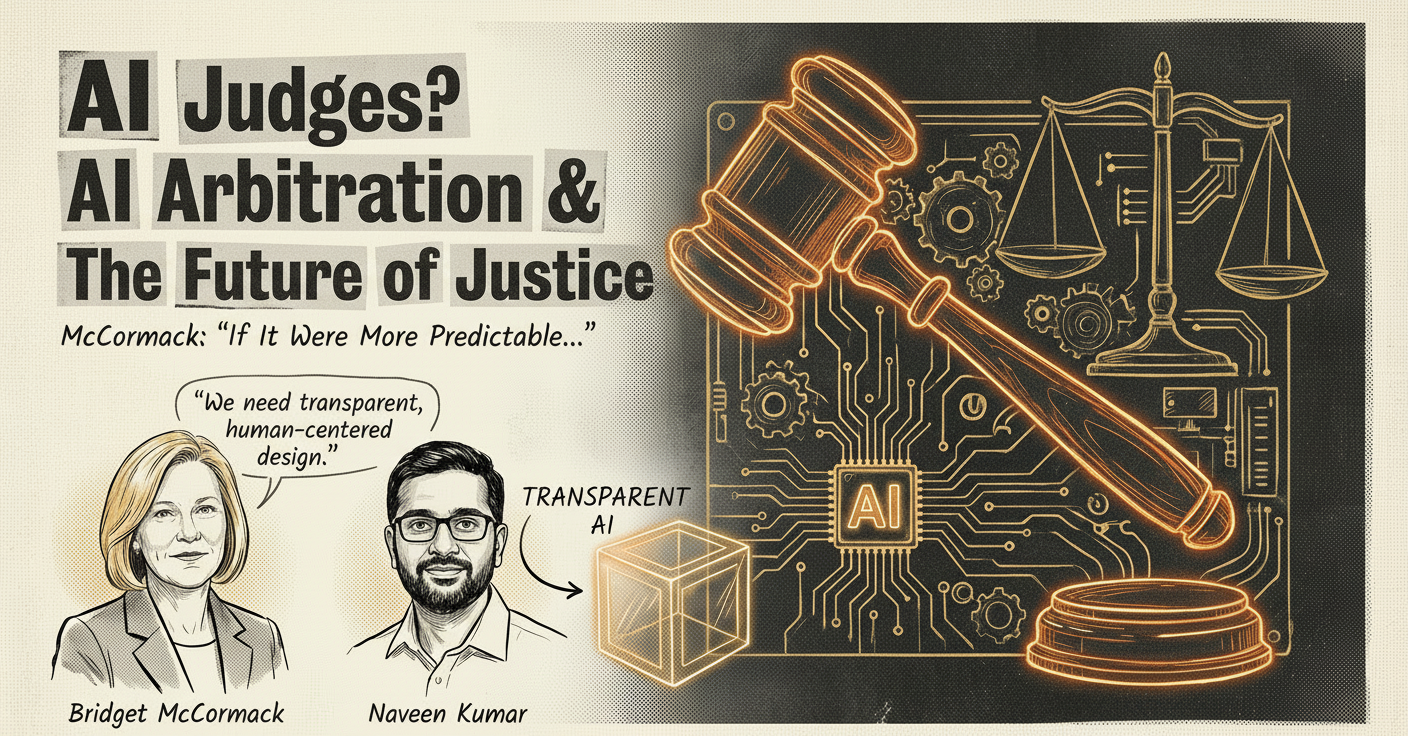
The legal system, seemingly impervious to radical change, is getting an AI overhaul. This week, we heard multiple signals that AI isn't just assisting lawyers; it's stepping into arbitration and even judging roles. Decoder with Nilay Patel featured Bridget McCormack, former Chief Justice of the Michigan Supreme Court, discussing the American Arbitration Association's new AI Arbitrator. Initially targeting documents-only construction disputes, the system aims to boost trust by transparently showing its reasoning – something human judges often don't provide. This is a crucial distinction: AI isn't just about speed; it's about transparent, auditable processes. The potential?
"If it were more predictable, we would be a more efficient and effective system. We'd avoid a lot of disputes because people could plan their business around what in fact the rule was going to be and how it was going to be enforced."
— Bridget McCormack, President and CEO of American Arbitration Association
This shift isn't confined to courtrooms. The same forces—demand for predictability, efficiency, and transparency—are at play across regulated industries like financial services. Naveen Kumar of TD Bank highlighted that AI's output must be auditable and transparent for enterprise adoption. If the legal system, with all its human-centric traditions, is embracing AI for fairness and trust, it signals a massive opportunity for any business dealing with complex, document-driven processes to gain both efficiency and credibility.
The move: Investigate how AI arbitration and transparent, auditable AI processes could enhance fairness and efficiency in your own internal disputes or customer-facing operations. Start asking for transparent AI reasoning.
The Rundown
① The Romance Novel Industry is AI's New Wild West.Hard Fork reports how AI tools are enabling authors like Coral Hart to publish over 200 books a year, transforming their role from 'author' to 'director'.
- Why it matters: This isn't just about fiction; it's a potent illustration of AI's power to radically scale creative output. If AI can churn out romance novels, what white-collar creative tasks in your business are next?
② XAI is planning data centers… in space.AI Breakdown revealed Elon Musk's XAI is pursuing orbital AI data centers using SpaceX's Starship, aiming for future cost reduction and strategic differentiation.
- The context: This audacious move isn't just about compute; it's about vertical integration and controlling the entire tech stack, from launch to AI research, to gain a competitive edge.
③ OpenAI's hardware device delayed until 2027.The AI Daily Brief confirmed OpenAI's hardware debut is pushed, while Chinese AI labs are rapidly closing the innovation gap.
"Weylander said that OpenAI had since decided not to use the IO name in any of their naming or marketing. The filing also spelled out the release schedule for the device, stating that it won't be available for sale until the end of February 2027."
— Nathaniel Whittemore, Host of The AI Daily Brief: Artificial Intelligence News and Analysis
- What to watch: The global AI race is intensifying, with the UAE positioning itself as a neutral third power. This delay gives competitors a critical window to innovate or catch up.
④ AI Safety is finally shifting from voluntary to mandatory reporting. Sean McGregor, co-founder of the AI Verification & Evaluation Research Institute on Practical AI, emphasized the critical need for mandatory incident reporting and third-party audits to prevent recurrence, drawing parallels to aviation safety.
- Why it matters: As AI moves from research to practical application, the industry is maturing. Expect more regulation and a higher bar for "safe" deployment, requiring robust audit trails and detailed incident logs across your AI use cases.
⑤ Autonomous Vehicles now value time more than data, compute, or talent.NVIDIA AI Podcast guests highlighted that the primary bottleneck in AV development is the exponential effort for marginal safety improvements, making efficient simulation and "data curation" paramount.
- The context: This signals a broader trend in complex AI deployments: raw resources are no longer the bottleneck. It's the strategic, intelligent application and curation of data and compute that drives progress.
The Signals
🟢 HOT
- Neural Reconstruction: Unmatched fidelity in AV simulation, making previously useless data valuable for augmentations. (NVIDIA AI Podcast)
- AI Arbitrator: Boosting trust in legal systems through transparent reasoning, even for complex cases. (Decoder with Nilay Patel)
- Multi-agent AI systems: Capable of parallel discussions and varied configurations for optimized outcomes, outperforming humans in some scientific discoveries. ("The Cognitive Revolution" | AI Builders, Researchers, and Live Player Analysis)
🟡 WARMING UP
- 🆕 AI in romance novel writing: Powering authors to publish hundreds of books annually, transforming the creative process. (Hard Fork)
- 🆕 Jeff Dean: Google's Chief AI Scientist, emphasizing strategic investment in both high-frontier and efficient "Flash" models. (Latent Space: The AI Engineer Podcast)
- 🆕 OpenClaw: Enabling non-technical users to build and manage 10-agent AI teams with surprising ease. (The AI Daily Brief: Artificial Intelligence News and Analysis)
🔴 COOLING OFF
- OpenAI's profitability isn't guaranteed: R&D costs for new models can exceed gross profits, challenging long-term viability without massive funding. (Azeem Azhar's Exponential View)
- Legal system is not deterministic: Despite desire for predictability, the human element introduces variability. AI aims to standardize this. (Decoder with Nilay Patel)
The Debate
Is AI integration disrupting white-collar work at an accelerating pace, or is it an overhyped "SaaS Apocalypse?"
🐂 The bull case:
"I think that if and when this does start to, you know, eat away at some of these white-collar industries, I think the backlash is going to be furious."
— The New York Times, Host at Hard Fork
🐻 The bear case:
"I think currently focus is on getting productivity efficiency out of AI rather than really worrying about what information we're using."
— Naveen Kumar, Head of AI Governance at TD Bank
Our read: The market is certainly reacting (just look at the "SaaS apocalypse"). While some operational leaders (like Kumar) are still focused on internal efficiencies and risk mitigation, others are seeing the writing on the wall for broader job displacement. The truth is likely in the middle: efficiency gains will eventually lead to headcount adjustments, but the pace and scale are still being debated.
The Bottom Line
The AI event horizon isn't a distant singularity—it's the sum of countless micro-disruptions fundamentally changing how work gets done, from the highly creative to the meticulously regulatory.
🎯 Your Move
- Task your legal or compliance team to assess AI arbitration platforms: This isn't just about dispute resolution; it's a test case for transparent, auditable AI. Understanding its mechanisms will prepare you for similar shifts in other regulated workflows.
- Identify a creative, white-collar process in your business for AI augmentation: The romance novel industry's embrace of AI for rapid content creation is a canary in the coal mine. Could your marketing, legal, or content teams scale output 10x-20x with similar tools?
- Schedule a "future of work" sprint to redefine roles under advanced AI agents: With tools like OpenClaw enabling non-technical users to build 10-agent teams and the market already pricing in white-collar job disruption, proactively redefine roles around AI, not against it.
What We Listened To
1. Decoder with Nilay Patel: "The surprising case for AI judges"
Runtime: 73 min
Featuring: Bridget McCormack (President and CEO, Former Chief Justice of the Michigan Supreme Court, American Arbitration Association), Nilay Patel (Editor-in-Chief and Host of Decoder, The Verge), Bridget Mary McCormack (President and CEO, American Arbitration Association)
This episode is worth your time if you're grappling with trust in institutions and the potential for AI to introduce both transparency and new challenges in traditionally human-centric decision-making processes.
"92% of Americans can't afford help with their legal problems... The rate of reversals by appellate courts is not a low number... Lack of faith and trust in our institutions is pervasive across American society. The legal system is just part of it now."
— Bridget McCormack, President and CEO of American Arbitration Association
2. The AI in Business Podcast: "From Demos to Defensible in Financial Services Copyright & Compliance for Enterprise AI - Naveen Kumar of TD Bank"
Runtime: 19 min
Featuring: Naveen Kumar (Head of AI Governance, TD Bank), Matthew DeMello (Editorial Director, Emerj AI Research)
Worth your time if you're in financial services or another regulated industry and need practical guidance on navigating copyright, compliance, and data governance for enterprise AI from someone actively implementing these policies.
"Copyright risk is when AI outputs content that it learned from copyrighted resources, for example internal external documents, training data or even online content."
— Naveen Kumar, Head of AI Governance at TD Bank
3. Hard Fork: "‘Something Big Is Happening’ + A.I. Rocks the Romance Novel Industry + One Good Thing"
Runtime: 61 min
Featuring: The New York Times (Host, The New York Times), Alexandra Alter (Reporter, The New York Times), Molly Holder (VP of Personalization, Spotify)
This episode is a must-listen if you want to understand the current market volatility around SaaS stocks, the accelerating pace of AI development, and its surprising-yet-significant impact on creative industries like romance novels.
"In one case, she reported on a writer who went from writing about 10 books a year, which is already a lot, to now doing more than 200 romance novels a year with the help of AI."
— The New York Times, Host at The New York Times
4. AI Breakdown: "XAI's Radical Plan: Data Centers In Space"
Runtime: 19 min
Featuring: Jaden Shafer (Host, AI Breakdown)
Worth your time if you're interested in the bleeding edge of AI infrastructure, specifically how vertical integration (SpaceX + XAI) could redefine compute economics with orbital data centers.
"The cheapest place to run large scale AI within a few years is going to be in orbit."
— Jaden Shafer, Host of AI Breakdown
5. Practical AI: "AI incidents, audits, and the limits of benchmarks"
Runtime: 43 min
Featuring: Sean McGregor (Co-founder and Lead Research Engineer, AI Verification & Evaluation Research Institute), Chris Benson (Principal AI Research Engineer, Lockheed Martin), Daniel Whitenack (CEO, Prediction Guard)
This episode is essential for anyone involved in AI deployment, focusing on the critical need for robust incident reporting, third-party audits, and meta-evaluation of benchmarks to ensure practical AI safety.
"Practical AI is the AI that has consequences and matters in the world and those are the ones who actually care to look into where it goes wrong."
— Sean McGregor, Co-founder and Lead Research Engineer at AI Verification & Evaluation Research Institute; Founder of AI Incident Database
6. Latent Space: The AI Engineer Podcast: "Owning the AI Pareto Frontier — Jeff Dean"
Runtime: 84 min
Featuring: Jeff Dean (Chief AI Scientist, Google), Alessio Fanelli (Host, Kernel Labs), Shawn Wang (Host, Latent Space)
This episode is a must-listen for technical leaders and strategists, offering a deep dive into Google's dual AI strategy (frontier models + efficient "Flash" models) and the intricate co-design of hardware and ML research.
"I think what we want to do is always have kind of a highly capable, sort of affordable model that enables a whole bunch of lower latency use cases. People can use them for agentic coding much more readily and then have the high-end, you know, frontier model."
— Jeff Dean, Chief AI Scientist at Google
7. "The Cognitive Revolution" | AI Builders, Researchers, and Live Player Analysis: "Approaching the AI Event Horizon? Part 1, w/ James Zou, Sam Hammond, Shoshannah Tekofsky, @8teAPi"
Runtime: 92 min
Featuring: Erik Torenberg (Host, The Cognitive Revolution), James Zou (Professor, Stanford University), Sam Hammond (Chief Economist, Foundation for American Innovation), Nathan Labenz (Host, The Cognitive Revolution), Shoshannah Tekofsky (Member of Technical Staff at Sage, Sage (AI Village))
Worth your time for eye-opening insights into AI's role in scientific discovery and the geopolitical implications of a "software-only singularity" that could rapidly reshape global economic dynamics.
"We've also experimentally validated and tested them in the real world and show that they're actually in many cases more effective than some of the human designed previously human designed nanobodies. So I think it's actually a very nice demonstration of how the agents can greatly accelerate the discovery process."
— James Zou, Professor at Stanford University
8. Decoder with Nilay Patel: "Siemens CEO's mission to automate everything"
Runtime: 63 min
Featuring: Nilay Patel (Editor in Chief, The Verge), Roland Busch (President and CEO, Siemens), The Verge (Host, The Verge)
This episode is crucial for leaders in industrial sectors, revealing how Siemens, a 170-year-old giant, is undergoing its fastest transformation yet by unifying efforts and leveraging AI across its diverse, global businesses.
"There's one constant in our history which is that we reinvented ourselves over and over again. And absolutely we are now in the midst of another reinventional transformation with one difference. This is the fastest and the most fundamental one we ever had because of technology."
— Roland Busch, President and CEO of Siemens
9. Azeem Azhar's Exponential View: "Inside the economics of OpenAI (exclusive research)"
Runtime: 50 min
Featuring: Azeem Azhar (Host, Exponential View), Jaime Sevilla (Founder, Epoch AI), Hannah Petrovic (Exponential View), Matt Robinson (Financial Journalist, AI Street), Jaime (Co-presenter), Hannah (Co-presenter)
This episode is a must-listen if you want a frank assessment of OpenAI's financial realities, including the staggering R&D costs of frontier models and the true bottlenecks in AI infrastructure.
"If you look at how much they spent in R and D in the four months before they released GPT5, that quantity was likely larger than what they made in gross profits during the whole tenure of GPT5 and GPT5.2."
— Jaime Sevilla, Founder of Epoch AI
10. NVIDIA AI Podcast: "Driving Safer AVs Faster with Smart Simulation, Neural Reconstruction, and Data-Centric Tools - Ep. 289"
Runtime: 45 min
Featuring: NVIDIA (Host, NVIDIA AI Podcast), Rohan Bhasin (Senior Solutions Engineer for Sensor Simulation, Fortellix), Dan Gural (Head of Technical Partnerships and Machine Learning Evangelist, Voxel51), Daniel Garau (Speaker, Voxel51), Rohan (Speaker, Fortellix)
Worth your time if you're involved in AV development or any complex AI system, offering insights into prioritizing time over raw data/compute and the power of neural reconstruction and data curation for accelerated progress.
"The most valuable resource when you're developing an AV System is not GPUs, it's not data, it's not people, it's time."
— Dan Gural, Head of Technical Partnerships and Machine Learning Evangelist at Voxel51
11. The AI Daily Brief: Artificial Intelligence News and Analysis: "How the Global AI Race Has Shifted"
Runtime: 25 min
Featuring: Nathaniel Whittemore (Host, The AI Daily Brief: Artificial Intelligence News and Analysis), Peter Weylander (General Manager, OpenAI), Tony Wu (Co-founder, xAI), Jimmy Baugh (Co-founder, xAI), Roland Gavrilescu (AI Researcher, xAI), Hang Gao (Multimodal AI Researcher, xAI), Satya Nutella (Satirical Poster), Theo Wait (Reporter, The Information), Dennis Stock Trader Network (Commentator), Neil Sipes (Analyst, Bloomberg Intelligence), John Belton (Commentator, Gabelli Funds), Jason Wang (CEO, Altruist), Will Rind (CEO, Granite Shares Advisors), Demis Hassabis (CEO, Google DeepMind), Justin Lin (Technical Lead for Kwen models, Alibaba), Robert at Baguan (Writer), Peng Zhao (CEO, G42), Elizabeth Warren (Senator), Jim Banks (Senator), Dario Amade (CEO, Anthropic), Howard Lutnick (Secretary, Commerce Department)
This episode is critical for understanding the evolving geopolitical landscape of AI, including OpenAI's hardware delays, the rapid rise of Chinese AI, and the UAE's strategic positioning.
"The blood in the streets has moved to financials as Wall street starts selling anything that AI might disrupt. Tuesday's installment of the AI market meltdown was courtesy of a new tax management tool from a startup called Altruist."
— Nathaniel Whittemore, Host of The AI Daily Brief: Artificial Intelligence News and Analysis
12. The AI Daily Brief: Artificial Intelligence News and Analysis: "How I Built My 10-Agent OpenClaw Team"
Runtime: 23 min
Featuring: Nathaniel Whittemore (Host, The AI Daily Brief: Artificial Intelligence News and Analysis)
Worth your time if you're a non-technical leader looking to understand the practicalities and ROI of building your own multi-agent AI teams, with a focus on persistence, mobile management, and security trade-offs.
"The point that I'm trying to make here is that if you have the will and are willing to put in the time, it doesn't matter how non technical you are, you can go build an agent team with OpenClaw right now, today, without asking anyone permission to do so, without needing to secure any additional resources first."
— Nathaniel Whittemore, Host of The AI Daily Brief: Artificial Intelligence News and Analysis