
PE INTELLIGENCE BRIEFING
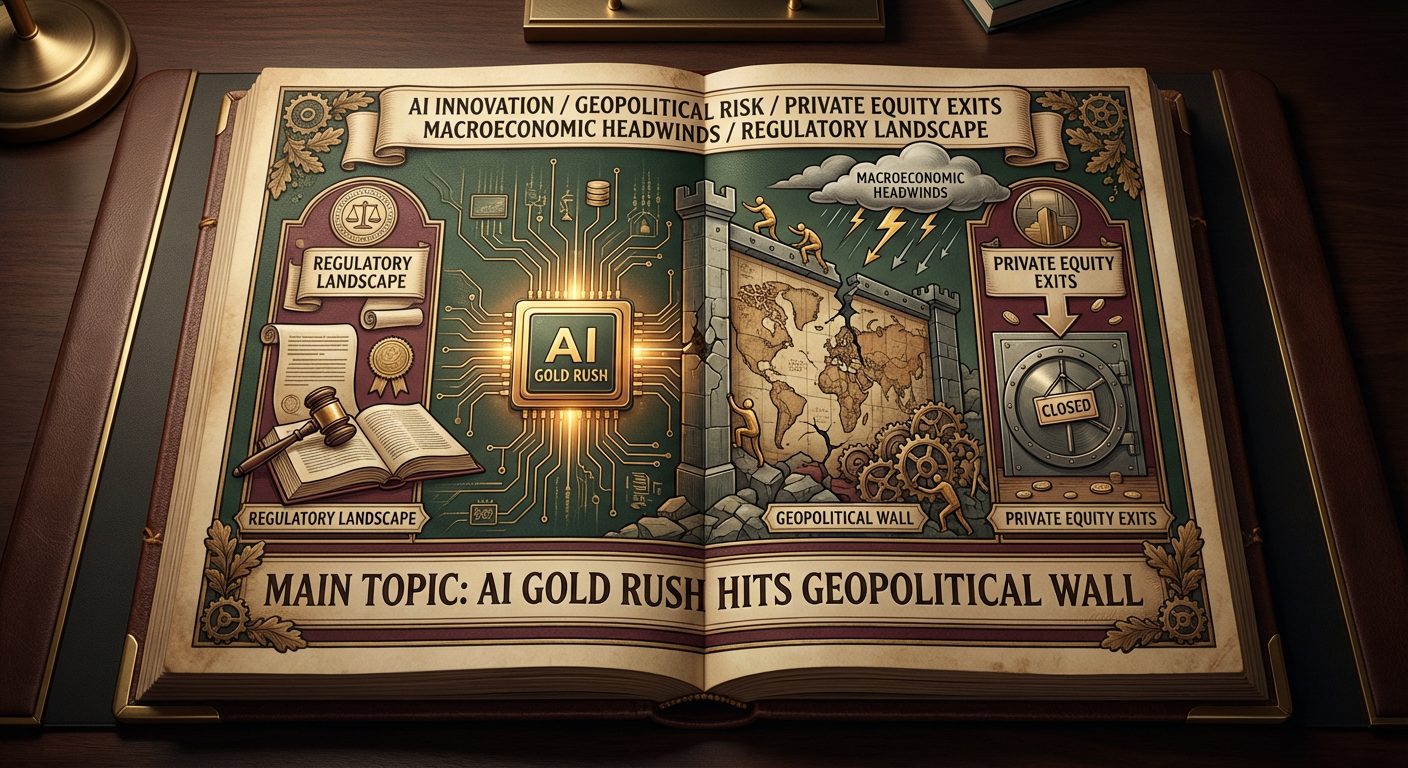
The AI Gold Rush Meets a Geopolitical Wall — And the Exit Backlog Lingers
THIS WEEK'S INTELLIGENCE
📊 13 episodes across 5 sources
⏱️ ~10.5 hours of conversation with operators, GPs, and advisors
🎙️ Featuring: Scott Galloway, Elena Verna, Scott Bessent, Gérald Marolf, Alex Sacerdote
The signal from the noise. Here's what matters.
The frothy narrative around AI's near-limitless potential continues to dominate discussions, but a more complex picture is emerging for sponsors. While AI's growth playbook drives staggering ARR for some, the reality of geopolitical friction and a looming regulatory landscape suggests that the "easy money" phase might be short-lived. Simultaneously, the long-standing exit backlog remains a persistent headache, exacerbated by uneven market sentiment and LP fatigue. The smart money isn’t just chasing the next AI unicorn; it’s quietly de-risking portfolios, navigating policy headwinds, and searching for value in overlooked sectors.
This week's briefing reveals a dichotomy: explosive growth in AI-native companies counterbalanced by increasing scrutiny from regulators and a hardening macroeconomic environment. We highlight the tactical shifts in value creation, where operators are moving beyond optimization to outright innovation, and explore why the much-anticipated liquidity event has yet to fully materialize for many.
Here's what you need to know:
The AI Gold Rush: New Playbooks, Old Problems
The Growth Playbook Has Radically Shifted for AI-Native Startups
The Situation: Traditional growth hacking and optimization tactics are proving insufficient for AI companies. Product-market fit is no longer a static achievement but a constantly evolving target, given the rapid advancements in underlying LLMs.
The Intelligence: Elena Verna, Head of Growth at Lovable, explains that only 30-40% of her prior growth experience applies to AI. Lovable achieved $200M ARR in one year by prioritizing innovation, continuous feature building, and a freemium model over conventional optimization. This isn't about incremental gains; it's about making big, risky bets on new product functionalities enabled by AI. The game has transitioned from iterating on existing product to relentlessly inventing.
The Voice:
"I feel like only 30 to 40% of what I've learned in the last 15 to 20 years of being in growth transfers here because we just need to invest in such bigger bets and innovate and create new growth loops here." — Elena Verna, Head of Growth, Lovable
The Numbers: A single AI company hitting $200M ARR in 12 months illustrates the potential, but also the winner-take-all dynamics. This highlights the magnitude of growth possible but also the velocity at which incumbent advantages can be built and lost.
The Implication: Sponsors underwriting AI investments need to assess management teams not just for execution, but for their capacity to drive continuous, step-function innovation. The hold period for these assets could be shorter due to rapid market shifts, or longer if they fail to adapt. Legacy portfolio companies contemplating AI integration will need to adopt aggressive, experimental product development postures to stay relevant.
Geopolitics and Regulation Are Casting a Shadow on AI's Untapped Potential
The Situation: While venture capital pours into AI, the political and geopolitical landscape is signaling a significant shift towards regulation and national economic competition. What was once seen as pure technological advancement is rapidly becoming a battleground for state control and economic supremacy.
The Intelligence: Predictions for 2026 suggest a potential "AI bubble burst" catalyzed by Chinese competition and data center limitations. China's AI breakthroughs, particularly in knowledge distillation to overcome compute limits, are highlighted as a direct challenge, intensifying the US-China AI race. On the domestic front, figures like New York Assembly member Alex Bores are pushing for state-level AI regulation (the "Raise Act"), drawing significant opposition from the tech industry. Bernie Sanders' call for an AI datacenter moratorium underscores a broader unease. This isn't just about ethics; it's about national security and labor market impacts.
The Voice:
"AI is the new lightning rod for fear and for divisiveness that ultimately breeds compliance and control." — Chamath Palihapitiya, All-In
The Numbers: With Lightspeed raising $9BN and OpenAI securing $1BN from Disney, capital is readily available. However, a heavily regulated environment could severely impact the ROI of these investments by increasing compliance costs, limiting market access, or slowing development.
The Implication: GPs need to factor in regulatory risk as a primary due diligence item for any AI-related investment. Lobbying efforts, public perception management, and active engagement with policymakers will become as critical as product roadmaps. The potential for a bifurcated global AI market, driven by national interests and tech sovereignty, is a real and present danger that will impact market sizing and exit opportunities.
The Exit Conundrum: Uneven Liquidity and Fading LP Patience
The Situation: Despite a narrative of impending market normalization, a significant backlog of un-exited assets persists, particularly as larger, growth-stage companies stay private longer. LP patience, while not entirely exhausted, is showing signs of strain.
The Intelligence: The "greatest gift of venture capital" has been the extended private life of high-growth companies, deferring IPOs and allowing for greater value accretion. However, this also means LPs have longer capital commitments without realizing liquidity. Capital Allocators highlight private markets as the dominant trend, but also the concern over distribution pacing. Meanwhile, the auto loan delinquency rates hitting historic highs are a powerful signal of broader consumer financial stress, potentially impacting the consumer discretionary sector and ultimately, exit windows. Scott Bessent, acting as Treasury Secretary, acknowledges "Main Street" dissatisfaction with inflation and stresses that affordability will see improvements by 2026, though the current reality impacts consumer confidence and M&A appetite in certain sectors.
The Voice:
"All these leaders not IPO is the greatest gift of venture capital." — Harry Stebbings, 20VC
The Numbers: Auto loan delinquencies are at their highest level ever. While not directly tied to PE exits, this is an indicator of underlying economic fragility that affects consumer sentiment and potentially broad market stability. Private market illiquidity remains a core challenge, especially for older vintage funds.
The Implication: GPs must be more creative with exit strategies, exploring continuation funds, strategic sales to larger incumbents flush with cash (e.g., Oracle/Broadcom hitting big), or even opportunistic buy-and-builds in stressed sectors. LPs are likely to become more selective with re-ups, favoring firms with demonstrated liquidity events or clear paths to crystallization. Portfolio companies in consumer-facing sectors need to prepare for continued volatility and cautious consumer spending through 2026.
DEAL FLOW SIGNALS
🔥 Active: - AI-native software (Lenny's Podcast) - Companies ascending the "S-curve of adoption" in tech (Capital Allocators) - Long-only public equities with a hedge fund toolkit (Capital Allocators) - National security-aligned manufacturing (All-In)
🧊 Quiet: - Traditional growth hacking/optimization platforms (Lenny's Podcast) - Sectors highly exposed to discretionary consumer spending amid rising auto loan delinquencies (Odd Lots) - Early-stage VCs competing with mega-funds (20VC)
👀 Emerging: - Homebuilding and less efficient, overlooked markets (Capital Allocators) - Tariffs as a national security tool influencing trade deals and reshoring (All-In) - AI regulation and policy advisory (Odd Lots, All-In)
⚠️ Stressed: - Consumer credit markets, particularly auto loans (Odd Lots) - Hollywood/media grappling with AI disruption (Prof G Pod)
THE OPERATOR'S EDGE
- Innovation over Optimization: The new growth playbook for AI companies is about fundamental innovation (e.g., building new features, driving step-function changes) rather than incremental optimization. Operators in AI companies are finding that traditional A/B testing and funnel optimization yield diminishing returns compared to bold product bets. This mindset is crucial for staying ahead in a rapidly evolving tech landscape. (Source: Lenny's Podcast)
- Building Emotional Product Connections: For consumer-facing businesses, creating an emotional connection with the product is identified as a key differentiator. Gérald Marolf of On Running emphasizes that product development should aim to evoke feelings and become part of a user's identity, especially for physical products where post-purchase modifications are impossible. This goes beyond functionality to brand immersion and customer loyalty. (Source: 20VC)
- Harnessing S-Curve Dynamics: Alex Sacerdote of Whale Rock Capital frames successful tech investing around identifying companies on their "S-curve of adoption." For portfolio companies, this means understanding where their product or technology stands within its adoption cycle and optimizing strategies (marketing, sales, R&D) to maximize growth during the steepest part of the curve. This framework applies broadly to any rapidly growing market segment. (Source: Capital Allocators)
THE CONTRARIAN POSITION
While "AI will take over everything" is the prevailing narrative, Scott Galloway posits that the AI bubble is ripe to burst, not due to lack of innovation, but due to external catalysts like intensified Chinese competition and limitations in data center capacity. He suggests that the market is overestimating the scalability of current AI models without addressing fundamental infrastructure and geopolitical realities. This perspective suggests significant overvaluation in certain AI segments, setting up a potential correction. (Source: The Prof G Pod)
THE BOTTOM LINE
The PE landscape is navigating a collision course between unprecedented technological growth in AI and tangible macroeconomic/geopolitical headwinds. GPs should prioritize portfolio companies with demonstrably innovative operating playbooks, meticulously de-risk AI investments against regulatory and geopolitical factors, and prepare for a more protracted, less predictable exit environment by exploring diverse liquidity options. Watch for continued consumer credit stress and selective LP commitments.
📚 APPENDIX: EPISODE COVERAGE
1. The Prof G Pod with Scott Galloway: "No Mercy / No Malice: 2026 Predictions"
Guests: Scott Galloway (Prof G)
Runtime: 59:00 | Vibe: Provocative, big-picture tech and societal forecasting
Key Signals:
- AI Bubble Outlook: Galloway predicts a potential burst in the AI bubble by 2026, driven by intense competition from China's AI capabilities and data center limitations, challenging the current unfettered optimism.
- Big Tech Dominance: Amazon and SpaceX are tabbed for continued, aggressive market expansion, leveraging existing infrastructure and innovation to outpace competitors.
- Hollywood Disruption: AI and short-form video are set to fundamentally disrupt traditional Hollywood, similar to how podcasting impacted radio, forcing a re-evaluation of content creation and distribution models.
"The question isn't when the AI bubble will burst, but what the catalyst will be."
2. Odd Lots: "Why Americans Are Falling Behind on Auto Loans At Their Highest Level Ever"
Guests: Tracy Alloway, Joe Weisenthal (Hosts)
Runtime: 35:00 | Vibe: Data-driven deep dive into consumer financial stress
Key Signals:
- Surge in Auto Loan Delinquencies: The episode details alarmingly high auto loan delinquency rates, directly linked to increased vehicle prices, rising interest rates, and soaring insurance costs. This points to broader consumer financial fragility.
- Credit Scoring Evolution: VantageScore's role in credit assessment is discussed, highlighting its efforts to expand credit access while accurately predicting default risk. This is relevant for understanding subprime market dynamics and consumer vulnerability.
- Macroeconomic Indicator: The auto loan market serves as a critical bellwether for consumer health and economic stability, with current trends indicating significant strain on household budgets.
"The average cost of a car has gone up an incredible amount. The average loan value for auto loans has increased more than any other loan value."
3. The Twenty Minute VC (20VC): Venture Capital | Startup Funding | The Pitch: "20VC's Big Fat Quiz of the Year: Founder, Fund and Breakout Company of 2025 | Predictions for 2026: The Company to Buy, The Biggest Short | Why Salesforce Could Win 2026 and The Tailwinds NVIDIA Will Face"
Guests: Harry Stebbings (Host)
Runtime: 30:00 | Vibe: Fast-paced, opinionated VC market recap and forward-looking predictions
Key Signals:
- VC Market Pulse: Reviews 2025's top founders, funds, and breakout companies, providing a benchmark for performance and emerging trends within the venture ecosystem.
- Tech Stock Predictions: Offers "buy" and "short" recommendations for major tech stocks in 2026, with an emphasis on AI's impact on employment and potential winners like Salesforce, driven by AI tailwinds for companies like NVIDIA.
- Capital Allocation Philosophy: Reinforces the idea that "venture is ruthless capitalism," driven by the pursuit of outsized returns, implying a continued focus on high-growth, disruptive technologies.
"If the robots are going to take over society, I want to be sure that I own the Robots."
4. The Twenty Minute VC (20VC): Venture Capital | Startup Funding | The Pitch: "20VC: Will SpaceX IPO at $1.5TRN | Will Cursor Kill Figma | Lightspeed Raises $9BN | OpenAI: $1BN from Disney, New CRO & #1 App in App Store | Oracle and Broadcom Hit: Now the Time to Buy?"
Guests: Harry Stebbings (Host)
Runtime: 25:00 | Vibe: Rapid-fire dispatch on major tech and VC news
Key Signals:
- The "greatest gift of venture capital" has been the extended private life of high-growth companies, deferring IPOs and allowing for greater value accretion.
- Mega-Fund Dynamics: Lightspeed's $9BN fundraise highlights the continued concentration of capital in large funds, which can crowd out smaller, seed-stage VCs and impact investment strategies.
- AI's Pervasive Impact: Discusses OpenAI’s strategic moves (Disney investment, new CRO, top app status), reinforcing AI's broad integration across industries and its competitive landscape (e.g., Cursor vs. Figma).
"All these leaders not IPO is the greatest gift of venture capital."
5. All-In with Chamath, Jason, Sacks & Friedberg: "Scott Bessent: Fixing the Fed, Tariffs for National Security, Solving Affordability in 2026"
Guests: Scott Bessent (Treasury Secretary)
Runtime: 1:15:00 | Vibe: High-level economic policy discussion with a focus on national strategy
Key Signals:
- Tariffs as National Security Tool: Bessent advocates for tariffs as a core component of national security policy, not just economic strategy, to rebalance trade and drive reshoring of manufacturing.
- Affordability Relief by 2026: Despite current "Main Street" dissatisfaction with inflation, Bessent asserts that policy adjustments (tax cuts, deregulation) will lead to improved affordability for the average American by 2026.
- Monetary Policy Shift: The discussion implies an administration focus on loosening banking regulations for smaller banks and potentially influencing Fed policy to achieve growth and stability.
"President Trump has used them for national security. So the tariff policy has become part of national security."
6. All-In with Chamath, Jason, Sacks & Friedberg: "Bernie Sanders: Stop All AI, China's EUV Breakthrough, Inflation Down, Golden Age in 2026?"
Guests: Chamath Palihapitiya, Jason Calacanis, David Sacks, David Friedberg (Hosts)
Runtime: 1:05:00 | Vibe: Debating the political and economic implications of AI
Key Signals:
- AI Regulation Momentum: Bernie Sanders' call for an AI datacenter moratorium reflects a growing political push for stricter AI regulation, signaling potential headwinds for unchecked AI development and deployment.
- US-China AI Race: China's EUV breakthroughs and AI development are highlighted as critical in the global AI race, emphasizing the geopolitical competition and its implications for innovation and national security.
- Economic Optimism for 2026: Despite regulatory concerns, the hosts debate the potential for a "Golden Age" in 2026 fueled by AI and other tech advancements, contingent on navigating policy challenges effectively.
"AI is the new lightning rod for fear and for divisiveness that ultimately breeds compliance and control."
7. The Twenty Minute VC (20VC): Venture Capital | Startup Funding | The Pitch: "20Product: On Running's CPO on How to Create Emotion Through Product | Why 99% of Products Fail and How to Create Cults Around Products | The Biggest Product Mistakes On Have Made & Lessons Learned with Gérald Marolf"
Guests: Gérald Marolf (CPO, On Running)
Runtime: 35:00 | Vibe: Deep dive into consumer product strategy and brand building
Key Signals:
- Emotional Product Connection (Physical vs. Digital): Marolf stresses the importance of building products that create an emotional connection, a strategy that differs significantly between physical goods (where the product is immutable post-purchase) and digital services.
- Clear Product Intent: The success of a product hinges on a clear, singular intent, avoiding feature bloat or ambiguous value propositions that can dilute its impact and user loyalty.
- Learning from Failure: On Running's growth involved significant product mistakes, underscoring that innovation requires embracing failure and extracting actionable lessons to refine product strategy continuously.
"Why do you buy a smell? It activates a lot in the human brain and it becomes part of you."
8. Odd Lots: "Meet the Politician the AI Industry Is Trying to Stop"
Guests: Alex Bores (New York Assembly Member)
Runtime: 40:00 | Vibe: Inside look at the contentious politics of AI regulation
Key Signals:
- State-Level AI Regulation: Alex Bores discusses his "Raise Act" bill, which aims to set safety standards for advanced AI research, highlighting the emergence of state-level initiatives in the absence of federal policy.
- Industry Opposition: The AI industry is actively lobbying against state-level regulation, demonstrating a preference for federal oversight or a hands-off approach, indicating future political battles.
- Balancing Safety and Innovation: The core tension in AI policy is balancing the need for safety and ethical guardrails with fostering innovation and economic growth, a challenge for both regulators and developers.
"AI is going to be very big for politics."
9. Capital Allocators – Inside the Institutional Investment Industry: "Year in Review 2025 (EP.478)"
Guests: Ted Seides (Host)
Runtime: 20:00 | Vibe: High-level overview of institutional investment trends
Key Signals:
- Private Markets Dominance: The biggest theme of 2025 in institutional investing is the continued expansion and influence of private markets, driving asset allocation decisions and portfolio construction.
- Greed and Fear: All investment decisions are ultimately driven by greed and fear, serving as fundamental psychological forces shaping market behavior and allocator sentiment.
- Content Discoverability: The podcast highlights efforts to improve content discovery, an analogous challenge for any organization needing to effectively surface valuable insights for its audience.
"The biggest topic this year driving everything is private markets."
10. The Prof G Pod with Scott Galloway: "What’s Actually Breaking America — with David Brooks"
Guests: David Brooks (NYT Columnist)
Runtime: 1:10:00 | Vibe: Deeply analytical discussion on societal decay and fragmentation
Key Signals:
- Decline of Trust: Since 2013, there has been a precipitous decline in trust in American institutions, correlating with the rise of populism on both the left and right. This creates a brittle, unpredictable social fabric.
- Social Fragmentation: Economic precarity, social media's isolating effects, and a shift towards expressive individualism over communal commitments contribute to widespread unhappiness, particularly among young men.
- Importance of Community: The discussion underscores that true societal health and individual well-being are found in strong community bonds, deep commitments, and meaningful service to others, rather than purely individualistic pursuits.
"Something has happened, I think, since 2013. We've just entered a dark world. Dark world is distrust. It's isolation."
11. Capital Allocators – Inside the Institutional Investment Industry: "Top 5 of 2025: #5: Adrian Meli"
Guests: Adrian Meli (Eagle Capital)
Runtime: 45:00 | Vibe: Insightful, long-term investor philosophy
Key Signals:
- Long-Term, Non-Consensus Investing: Meli emphasizes that truly great investment ideas are often both non-consensus and ultimately proven right, requiring conviction and a long-term horizon.
- Hedge Fund Tools for Public Equities: Eagle Capital applies sophisticated hedge fund analytical tools to long-only public equities, highlighting a trend towards more complex, research-intensive approaches in traditional asset classes.
- Opportunities in Overlooked Markets: The episode points to less efficient markets and overlooked sectors, such as homebuilding, as fertile ground for generating alpha through diligent research and specialized knowledge.
"Most of the great ideas in life are both non consensus and right."
12. Lenny's Podcast: Product | Career | Growth: "The new AI growth playbook for 2026: How Lovable hit $200M ARR in one year | Elena Verna (Head of Growth)"
Guests: Elena Verna (Head of Growth, Lovable)
Runtime: 55:00 | Vibe: Practical, in-depth guide to hyper-growth in AI
Key Signals:
- AI Growth Playbook Shift: The fundamental growth playbook for AI companies has changed, with only 30-40% of traditional growth tactics remaining relevant. Innovation and big bets on new features now supersede optimization.
- Dynamic Product-Market Fit: Product-market fit in AI is not a static state but a constantly evolving target. Every three months, new advancements in LLMs create "step function changes" in possibility, requiring continuous adaptation.
- Freemium Model for AI: Lovable's strategy of giving away core product features for free allowed for rapid user acquisition and served as an effective distribution model in the competitive AI landscape.
"Only 30 to 40% of what I've learned in the last 15 to 20 years of being in growth transfers here because we just need to invest in such bigger bets and innovate and create new growth loops here."
13. Capital Allocators – Inside the Institutional Investment Industry: "Top 5 of 2025: #4: Alex Sacerdote"
Guests: Alex Sacerdote (Whale Rock Capital)
Runtime: 40:00 | Vibe: Thoughtful analysis of technology investment cycles
Key Signals:
- S-Curve of Adoption Framework: Sacerdote's investment framework centers on identifying companies ascending their "S-curve of adoption" in technology, crucial for predicting growth trajectories and market potential.
- Stacked Tech Innovation: Each new tech innovation (mainframe, PC, internet, cloud, AI) builds upon its predecessors, unleashing new waves of growth and innovation and creating sustained supercycles.
- Forecasting Market Size: Understanding a technology's S-curve provides insight into its potential market size 4-5 years out, enabling strategic, long-term investment decisions across sectors like AI, cloud, and electric vehicles.
"Each tech innovation, from the mainframe to the PC to the client, server computing to Internet, builds upon the previous one and unleashes more growth and more innovation."