
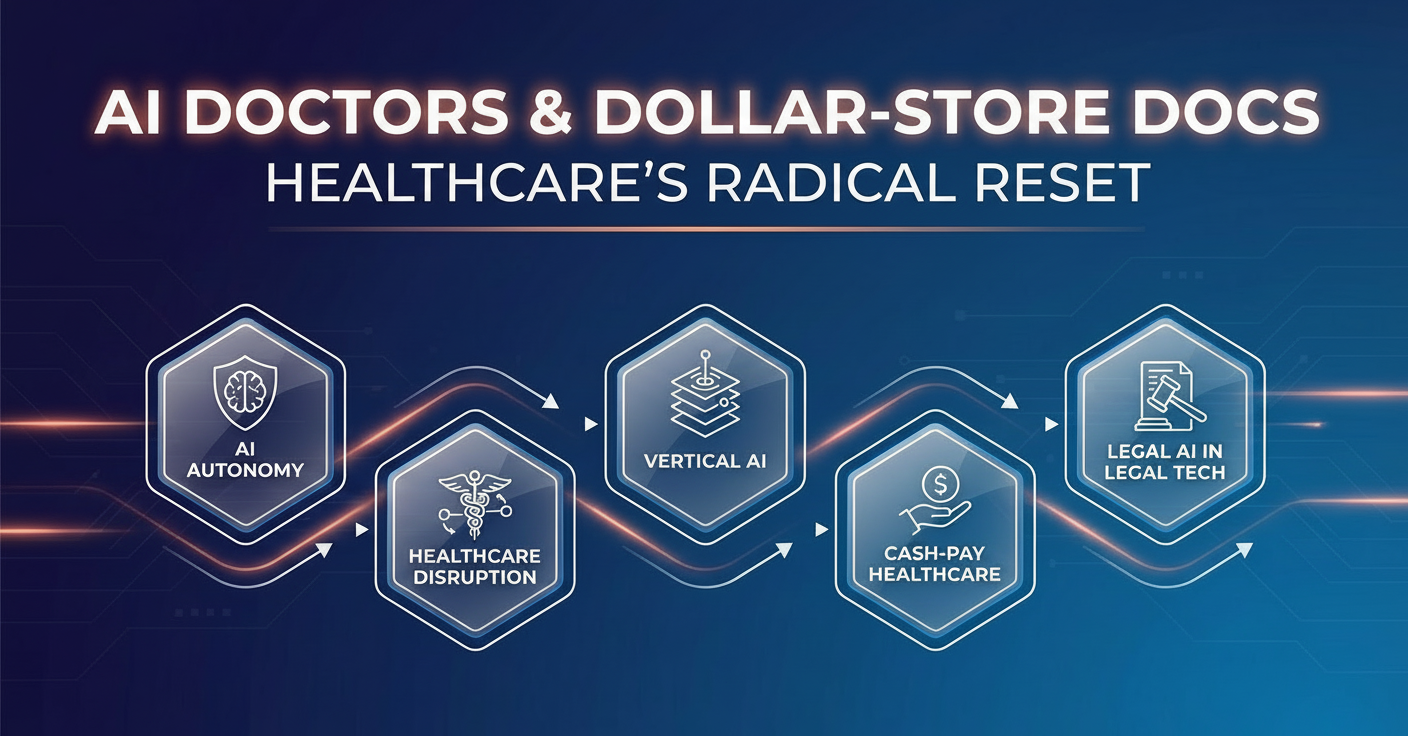
The AI doctors are in, literally this week, as conversations shifted from distant speculation to immediate deployment, fundamentally reshaping verticals from healthcare to legal tech.
The Intake
Where capital is flowing. What's getting funded. Insight from operators in the trenches.
This week's pattern recognition:
📊 10 episodes across 7 podcasts
⏱️ 631 minutes with GPs, founders, and LPs
🎙️ The voices: Max Junestrand (CEO, Legora), Harry Stebbings (Host, 20VC), Tommy Mello (Founder, A1 Garage Door), Paul Adams (CPO, Intercom)
The Big Shift
AI Is Not Just an Infrastructure Play Anymore—It's Exploding into Verticals with Full Autonomy
This week's intelligence reveals a seismic shift: AI is moving beyond infrastructure and into autonomous, decision-making roles within specific verticals, most notably legal and healthcare. Max Junestrand, CEO of Legora, highlighted a "winner-take-all" dynamic in legal AI, where their platform is now the most deployed gen-AI tool in top UK law firms, having shifted away from OpenAI to Anthropic due to enterprise suitability. Concurrently, Fred Almeida, CEO of American Medical Intelligence Inc., argues that AI will soon replace primary care doctors, handling diagnostics and triage before human specialists intervene. This isn't theoretical; it's being built and deployed now, changing competitive landscapes.
Why it matters: This rapid deployment of autonomous AI signals that the market is moving into a phase where incumbents will either integrate or be disrupted. It fundamentally alters the competitive moats and value capture points beyond just foundational models.
"I actually think that the future of where this is going to go is that the AI will become your doctor in a few more years. Your primary care doctor." — Fred Almeida, CEO of American Medical Intelligence Inc. on This Week in Startups
The move: Evaluate your portfolio and competitive landscape: which verticals are most susceptible to prompt AI-driven autonomy, and where can you position to capture that value?
The Rundown
① Blue-collar businesses are the new darlings of private equity. Tommy Mello (My First Million) highlighted that once-overlooked home service industries like garage door repair are attracting significant PE investment due to predictable income and sophisticated operational models, moving away from pre-COVID tech biases.
• The signal: Cash flow positive, recession-resilient businesses operating in large, fragmented markets are highly attractive, even if they lack perceived "tech glamor."
② Documentation is transitioning from human-centric reference to AI agent infrastructure. Mintlify co-founders (The a16z Show) revealed that docs are no longer just for developers; they're critical for AI agents, support bots, and internal tools. This elevates the importance of accurate, up-to-date information for AI to function correctly.
• Why it matters: Companies that excel at structured knowledge management and automated documentation are building a foundational layer for AI-driven operations, creating new competitive advantages.
③ Cold outreach, not just warm intros, is still king for breaking through. Harry Stebbings (20VC) shared how he leveraged a direct, persistent cold email strategy to land sponsorships and guests like Marc Benioff, emphasizing the power of social proof and FOMO.
"I emailed 25 of the biggest CEOs in technology. And I said that their competitors wanted to sponsor the podcast, but I was a fan of their product instead. Would they like to take it? I priced it at $95,000 each, just under the 100 grand procurement budget. And I got 19 of them. Say yes, they would love to. And that was $1.75 million in 24 hours." — Harry Stebbings, Host of 20VC
• What to watch: Outbound sales and networking strategies, particularly for founders, need to embrace personalized, persistent cold approaches alongside traditional networking.
④ Product growth stagnation is rarely about price; it's about deeper product issues. Jason Cohen (Lenny's Podcast) argues that "too expensive" is almost never the true reason for churn and that cancellations (not marketing) ultimately cap a company's growth.
• Why it matters: Founders and product leaders need to probe beyond superficial customer feedback to uncover "root-er" causes of churn, often tied to value perception, onboarding, or unmet needs.
⑤ Unbundling of health insurance is moving US healthcare towards a cash-pay, parallel system. Nikhil Krishnan and Jay Rughani (The a16z Show) discuss a growing trend of "insurance defection" driven by high premiums and deductibles, leading to a rise in cash-pay services and specialized low-cost care models.
• The signal: This creates a massive greenfield opportunity for startups that can deliver affordable, transparent, and consumer-directed healthcare solutions outside of traditional payer systems.
Capital Signals
🔥 HOT
• Legal AI: Legora's rapid deployment and shift from OpenAI to Anthropic signal a vertical where AI is quickly becoming embedded and competitive moats are forming. (Max Junestrand on The Twenty Minute VC)
• Home Services (PE interest): Predictable income and operational sophistication are attracting significant private equity investment. (Tommy Mello on My First Million)
👀 EMERGING
• AI as Primary Care: The shift from AI as a tool to AI as the primary diagnostic and triage layer for patients. (Fred Almeida on This Week in Startups)
• AI Agent Infrastructure: Documentation becoming a critical infrastructure layer for AI agents signals foundational investment opportunity. (Jennifer Li on The a16z Show)
🧊 COOLING
• Traditional SaaS (pre-AI native): Companies that haven't fundamentally "refounded" with an AI-first approach are struggling with declining growth. (Paul Adams on The Official SaaStr Podcast)
⚠️ CROWDED
• Generic AI infrastructure plays: While still hot, the specific shift away from OpenAI to model promiscuity indicates that the underlying model API layer is becoming commoditized. (Max Junestrand on The Twenty Minute VC)
The Debate
Should startups prioritize cutting-edge AI or focus on incremental market wins?
🐂 The bull case:
"Everything it has built has been flawless. I don't want to sound hyperbolic... Everything it's built has been one shot, basically. And this is not the only thing it's built." — Matt, Entrepreneur on This Week in Startups
🐻 The bear case:
"The only way to know if you've gone far enough is to go too far. The only way to know where there's a boundary is to cross the boundary." — Paul Adams, Chief Product Officer of Intercom on The Official SaaStr Podcast
Our read: While "Clawdbot" highlights the power of cutting-edge, autonomous AI to deliver "flawless" one-shot solutions, the imperative from Intercom's CPO is to aggressively "refound" an entire company around AI, even if it means going "too far." The synthesis suggests a need for both: embracing radical AI capabilities where appropriate, but understanding that fundamental business transformation is required to capture long-term value, not just quick wins.
The Bottom Line
The next wave of value creation will come from deeply integrated, autonomous AI solutions in specific verticals, forcing incumbents to undertake radical "refounding" or face disruption.
🎯 Your Move
- Audit your portfolio for AI readiness: Assess if companies are merely adding AI features or truly "refounding" their product, organization, and go-to-market strategies for an AI-first world.
- Explore healthcare unbundling opportunities: Research startups leveraging cash-pay models, direct-to-consumer diagnostics, and AI-driven personalized health protocols outside traditional insurance.
- Invest in knowledge infrastructure: Look for companies building tools that automate the creation, maintenance, and consumption of documentation, especially as it becomes critical for AI agents.
What We Listened To
1. The Twenty Minute VC (20VC): Venture Capital | Startup Funding | The Pitch: "20VC: From Only OpenAI to Die-Hard Anthropic: The Downfall of OpenAI in Enterprise | Harvey vs Legora: Legal AI is a Winner Take All | $7M ARR in a Single Day and Raising $200M Across 3 Rounds with No Deck with Max Junestrand, CEO @ Legora"
Guests: Max Junestrand (Co-Founder and CEO, Legora), Harry Stebbings (Host, 20VC) Runtime: 63 min | Vibe: Unvarnished insights into legal AI's hyper-competitive landscape.
Key Signals:
- Enterprise AI Shift: Legora's pivot from OpenAI to Anthropic models highlights that enterprise customers prioritize performance and suitability, not just brand, driving model promiscuity.
- Legal AI Consolidation: A "winner-take-all" dynamic is emerging in legal tech, where market leaders rapidly capture the lion's share of value, making early adoption critical.
- Rapid ARR Growth: Legora achieved $7M ARR in a single day, showcasing demand for deep vertical AI solutions and the power of strategic product pivots.
"Number one will grab 90% and number two to number 10 will share the remaining 10%. Got to run like hell. You got to win. There's no number two. There is only being number one." — Max Junestrand, CEO at Legora
2. The Twenty Minute VC (20VC): Venture Capital | Startup Funding | The Pitch: "20VC: Raising $400M for 20VC: Fundraising Lessons | Getting Marc Benioff Through 53 Cold Emails: How to Master Cold Outbound | 7 Lessons from 101 Decacorn Founders with Harry Stebbings (Simon Squibb Edition)"
Guests: Harry Stebbings (Host, 20VC), Simon Squibb (Entrepreneur and Founder, Project Europe) Runtime: 43 min | Vibe: Tactical advice on breaking through the noise in fundraising and networking.
Key Signals:
- Cold Outbound Mastery: Persistence and personalized cold emails can yield high-value connections and funding, even with top-tier executives.
- Relationship Building for Fundraising: Moving conversations to more personal platforms like WhatsApp fosters deeper connections, crucial for long-term fundraising success.
- FOMO as a Sales Lever: Strategic use of competition and limited offers can accelerate deal closure and sponsorship acquisition.
"I emailed Marc Benioff from Salesforce 53 times. Every time I put a new PS with a personalization. PS I hope the weather in X is nice. I knew you had a holiday home there. P.S. i hope that you're enjoying the McAllen 75. It's also my favorite. Every single time. I would do it again and again and again. It never stopped. And on the 53rd time, he responded and said he'd come on the show" — Harry Stebbings, Host of 20VC
3. My First Million: "How I Built a $1.7B Business Repairing Garage Doors"
Guests: Tommy Mello (Founder, A1 Garage Door), Sam Parr (Host, My First Million), Shaan Puri (Host, My First Million) Runtime: 74 min | Vibe: A masterclass in scaling a "blue-collar" business through systems and branding.
Key Signals:
- Scaling vs. Hustle: Successfully growing a substantial business requires a shift from pure entrepreneurial "hustle" to robust systems and leadership.
- Profit Over Revenue: Prioritizing profit for sanity, over chasing vanity metrics like revenue, is key for sustainable growth and long-term value.
- Power of Mentorship & Branding: Leveraging mentors for "blueprints" and investing in personal and company branding accelerates talent acquisition and customer trust.
"The hustler had to die for the leader to be born." — Tommy Mello, Founder of A1 Garage Door
4. Lenny's Podcast: Product | Career | Growth: "Why your product stopped growing (and the 5-step framework to restart it) | Jason Cohen"
Guests: Jason Cohen (Four-time founder (including two unicorns) and investor, WP Engine), Lenny Rachitsky (Host), Lenny (Host, Lenny's Podcast) Runtime: 106 min | Vibe: A diagnostic framework for product leaders grappling with stalled growth.
Key Signals:
- Churn's True Impact: Cancellations grow faster than marketing efforts, eventually capping a company's maximum achievable size regardless of acquisition.
- "Too Expensive" is a Red Herring: The real reasons for customer churn or non-conversion are rarely just about price, necessitating deeper inquiry.
- Complex "Root-er" Causes: Product growth issues usually stem from multiple interlocking factors, not a single root cause, requiring a multi-faceted approach.
"Cancellations grow faster than marketing. And so cancellations overpower the growth of the company and slow it to a halt... There's a maximum ceiling of how big you could ever be thanks to cancellations." — Jason Cohen, Four-time founder (including two unicorns) and investor
5. This Week in Startups: "Why You’ll Choose an AI Doctor (feat. Fred Almeida and Max Weiss) | E2239"
Guests: Fred Almeida (CEO, American Medical Intelligence Inc.), Maxwell Weiss (Partner, Pacific Bays Capital), Jason Calacanis (Host), Max Weiss (Guest), Jason (Host), Kaz (Founder CEO, Cascade), Maya (Founder, Outsource Global), Matt (Builder and Founder, Gomochi), Gigi (Founder, Random Chat), Eugene (Founder, AIR Inc.) Runtime: 63 min | Vibe: A provocative look into AI's imminent transformation of primary healthcare.
Key Signals:
- AI as Primary Care Provider: AI is positioned to become the first point of contact for healthcare, handling diagnostics and triaging for human specialists.
- Healthcare System Inefficiencies: Current medical systems disincentivize preventative tests and create administrative burdens, making them ripe for AI disruption.
- Japanese Tech Opportunities: Japan holds near-monopolies in critical semiconductor materials and offers cost-effective, high-talent technical labor, presenting unique startup opportunities.
"I actually think that the future of where this is going to go is that the AI will become your doctor in a few more years. Your primary care doctor." — Fred Almeida, CEO of American Medical Intelligence Inc.
6. The Official SaaStr Podcast: SaaS | Founders | Investors: "SaaStr 839: Why Most SaaS Companies Will Fail at AI (And How to Avoid It) with Intercom's CPO"
Guests: Paul Adams (Chief Product Officer, Intercom), SaaStr (Host, SaaStr) Runtime: 43 min | Vibe: A stark assessment of the radical transformation needed for SaaS companies to survive the AI era.
Key Signals:
- Mandatory "Refounding" for SaaS: Existing SaaS companies must completely overhaul their product, organization, metrics, and go-to-market strategies to become AI-first.
- Designers as Engineer: Intercom mandated that all designers ship code, highlighting the need for highly integrated, multi-disciplinary teams in an AI-first development environment.
- AI Product GTM Shift: The purchasing decision for AI-native products is now multi-stakeholder, involving C-level executives focused on AI transformation and AI-fluent specialists.
"You have to change everything. You have to refound your company. If you have a SaaS company and it predates AI and it's not an AI native company... You have to change everything. Your org, your product, your roadmap, how you build the metrics, how you measure success, how your sales team works, how you go to market, pricing..." — Paul Adams, Chief Product Officer of Intercom
7. The a16z Show: "How Mintlify Is Rebuilding Documentation for Coding Agents"
Guests: Han Wang (Co-founder, Mintlify), Hahnbee Lee (Co-founder, Mintlify), Jennifer Li (General Partner, a16z), Yoko Li (Partner, a16z), Han (Co-founder, Mintlify), Hanbi (Co-founder, Mintlify) Runtime: 45 min | Vibe: A deep dive into how developer documentation is becoming critical AI infrastructure.
Key Signals:
- Documentation as AI Infrastructure: Documentation is no longer just human reference; it's a foundational layer for AI agents, support bots, and internal AI tools.
- Manual Sales motions for Traction: "Do things that don't scale" approaches like manual customer migration and personalized doc reviews can build early traction and customer love.
- Agent-Centric Content Design: The shift from human-first to agent-first documentation design is critical for supporting the growing use of AI agents.
"Documentation matters more than ever, but keeping it accurate has always been one of the hardest problems in software. Static docs don't survive fast moving products, especially in an agent driven world." — Jennifer Li, General Partner at a16z
8. Founders: "#410 Excellent Advice for Living"
Guests: David Senra (Host, Founders Podcast), Kevin Kelly (Author), David (Host, Founders Podcast) Runtime: 38 min | Vibe: Timeless wisdom for entrepreneurs and individuals on leading a purpose-driven life.
Key Signals:
- Deadlines Drive Creativity: Deadlines are not limitations but powerful accelerators that force critical decisions and weed out the extraneous.
- Internal Forgiveness: Forgiveness of others is primarily a gift to oneself, releasing personal burdens and fostering well-being.
- Self-Directed Living: Avoid measuring personal success by others' standards; focus on your own chosen game and unique path.
"Always demand a deadline because it weeds out the extraneous and the ordinary. A deadline is often a creative accelerator, not a creative killer, because it forces decisions." — Kevin Kelly, Author
9. The a16z Show: "Healthcare 2026: AI Doctors, GLP-1s, and Insurance Defection"
Guests: Nikhil Krishnan (Founder, Out-of-Pocket), Jay Rughani (Investing Partner, Health and Bio, a16z), Erik Torenberg (Host, The a16z Show) Runtime: 94 min | Vibe: A prescient look at the structural shifts reshaping the American healthcare landscape.
Key Signals:
- Insurance Defection Trend: Rising premiums and deductibles are driving consumers away from traditional health insurance, leading to a surge in cash-pay options.
- Emergence of Parallel Systems: A two-tiered healthcare system is forming, with cash-pay options for elective and preventative care and government relief for catastrophic events.
- Startup Opportunity in Low-Cost Care: The unbundling creates a massive opportunity for startups to deliver affordable, transparent, and consumer-directed care.
"The rate of uninsured people will skyrocket to 15%, leading to consequences like flooded emergency rooms, spiking insurance premiums and more cash pay options." — Nikhil Krishnan, Founder of Out-of-Pocket
10. This Week in Startups: "Clawdbot is an inflection point in AI history | E2240"
Guests: Jason Calacanis (Host, This Week in Startups), Matt Von Horn (Co-founder & CEO, June (sold to Weber)), Alex Finn (Founder & CEO, Creator Buddy), Dan Penguine (Clawdbot power user), Jason (Host), Matt (Entrepreneur, Claudbot user), Alex (Guest), Dan (AI Safety CTO, Active Fence (now Caterpillar by Alice)), Matt Von Horn (Creator of Claude code skill, Cloudbot) Runtime: 62 min | Vibe: A provocative discussion on the disruptive potential of autonomous, open-source AI agents.
Key Signals:
- Autonomous AI Employees: Clawdbot is demonstrating the capability to act as a 24/7 AI employee with infinite memory, automating complex business tasks for SMBs and one-person SaaS.
- Open-Source AI Advantage: Open-source AI projects like Clawdbot are outpacing corporate development due to a lack of bureaucracy, enabling rapid, "one-shot" solutions.
- Local LLMs & Personal AI: The rise of local LLMs run on personal hardware (Mac Minis) signals a trend towards cost-effective, personalized "super intelligence" outside the cloud.
"I think this is the single greatest application of AI I've ever seen in my entire life. It is basically for me at least a 24/7 AI employee that works for you at all times, doesn't need to sleep, doesn't need to eat, doesn't complain. It is constantly doing work for me and improving my business." — Alex Finn, Founder & CEO of Creator Buddy