
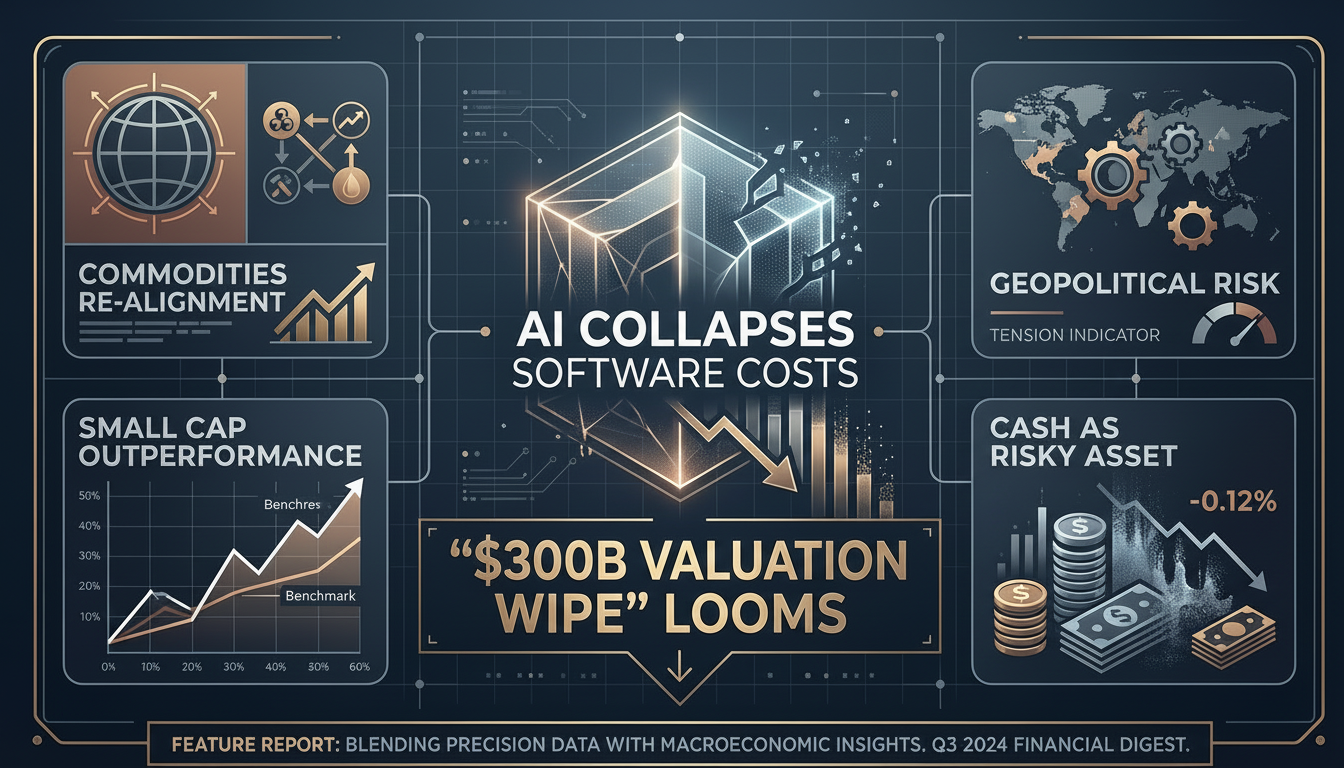
This week the smart money is moving to commodities and small caps. Here's what that shift means for your deal timing and capital structure decisions.
The Intake
Midweek macro. The patterns, levels, and positioning calls that the market is talking about.
This week's signal:
- 📊 12 episodes across 8 podcasts
- ⏱️ 657 minutes of market intelligence
- 🎙️ On the record: Michael Batnick, Kyle Grieve, Steven Forrester, The Investor's Podcast Network, Jim Bianco, Nathaniel Horwitz
The Big Shift
Commodities Have Re-aligned: Here's Why They're Not Just an Inflation Hedge Anymore
The conversation around commodities has shifted from being a mere inflation hedge to a strategic, geopolitically driven asset class with renewed demand drivers. PIMCO, a firm known for macro strategies, is actively leveraging momentum and carry to enhance commodity ETF returns (Greg Sharenow on Animal Spirits Podcast). This isn't just about rising prices; it's about a foundational re-alignment.
Why it matters: If you're building long-term models or assessing portfolio risk, commodities need to be viewed as a distinct, resilient asset class driven by new, structural factors—including AI-driven demand and geopolitical strategic stockpiling—rather than solely as a cyclical play.
"One of the things that differentiates today from many other periods in the past... particularly since when gold really became financialized... is a changing global landscape where political and geopolitical considerations, in addition to inflation considerations, have driven an interest..."
— Greg Sharenow, Managing Director and Portfolio Manager at PIMCO Real Assets on Animal Spirits Podcast
The level: Watch for continued investment surges in AI and defense, which are creating artificial demand, reminiscent of the 2000s supercycle, suggesting sustained strength irrespective of short-term inflation prints.
The Rundown
① Small Caps Are Primed for Outperformance. The market is transitioning to an earnings-driven cycle, which historically favors small-cap companies (Brian Belsky on Bloomberg Surveillance).
- Why it matters: If your portfolio is too concentrated in large-cap tech, you might be missing out on where the next phase of market growth will occur. Now is the time to reassess your exposure.
② AI is Collapsing Software Costs. Despite the hype, AI is rapidly driving down the cost of building software, threatening traditional SaaS pricing models and sparking a "$300 billion valuation wipe" (Jim Bianco on Bankless).
- The signal: This isn't just about certain companies, but a fundamental shift in software economics. Operators in software, or those reliant on it, need to re-evaluate their cost structures and pricing strategies before the market forces the change.
③ The Long-Term Risk of Holding Cash. Over 200 years of market data reveals that cash is a high-risk long-term asset due to an average real return of -2% annually (Jim Reid on The Meb Faber Show).
"The riskiest thing you can do in the long term is keep too much cash, really. So if you look at 200 years of data at a global level, the real return from cash is minus 2% per year."
— Jim Reid, Global Head of Macro Research and Thematic Strategy at Deutsche Bank on The Meb Faber Show
- The level: If your cash holdings exceed operational needs, consider their long-term erosive effect on purchasing power and shift towards productive assets.
④ The Rise of Non-Financial Crypto Use Cases. Beyond speculative trading, the crypto space is seeing significant developments in prediction markets and tokenized securities through DeFi infrastructure like Uniswap (David on Bankless).
- Why it matters: Ignore the noise around price action and focus on the underlying infrastructure being built. BlackRock's use of Uniswap for tokenized funds (Bankless) signals serious institutional engagement with DeFi, potentially changing how capital is raised and traded.
⑤ Geopolitical Shockwaves Redraw the Investment Map: Recent geopolitical events, like the seizing of Russian assets, have fundamentally shifted investor behavior and central bank gold buying patterns (Greg Sharenow on Animal Spirits Podcast).
- The signal: The shift towards asset security and diversification, even by state actors, should prompt all investors and operators to consider geopolitical risk as a primary driver, not a secondary one, when structuring capital and assets globally.
The Heat Map
🔥 HEATING UP
- Visa 🆕: Seen as a highly predictable growth stock with robust network effects and capital-light business model. (Clay Finck on We Study Billionaires)
- Commodities: New demand drivers (AI, energy transition, geopolitical security) are creating sustained strength, beyond just inflation hedging. (Greg Sharenow on Animal Spirits Podcast)
- Small Caps: Transitioning to an earnings-driven market, favoring smaller companies over momentum plays. (Brian Belsky on Bloomberg Surveillance)
👀 ON WATCH
- 🆕 Hunterbrook: An investigative journalism/hedge fund hybrid that uses reporting to find informational edge in markets. (Nathaniel Horwitz on The Compound and Friends)
- 🆕 Jim Bianco: Warning that AI is collapsing software building costs, threatening SaaS pricing models. (Jim Bianco on Bankless)
- Prediction Markets Regulation: Growing revenue for platforms like Robinhood but facing scrutiny from CFTC vs. state jurisdictions on insider trading. (David on Bankless)
🧊 COOLING OFF
- SaaS Apocalypse: AI advancements are collapsing software building costs, driving down valuations for traditional SaaS companies. (Jim Bianco on Bankless)
- High US Technology Stock Valuations: Concerns about elevated CAPE ratios and historical precedents for future returns. (Jim Reid on The Meb Faber Show)
- US Exceptionalism: Shifting investor perception that the period of US exceptionalism might be nearing an end. (Tom Wrobel on Top Traders Unplugged)
The Debate
Is the Soft Landing Narrative Still Viable, or Should Operators Plan for a Harder Landing?
🐂 The bull case:
"I'm still in the camp that there's maybe one more cut this year, possibly two."
— Jim Caron, CIO of Portfolio Solutions at Morgan Stanley Investment Management on Bloomberg Surveillance
🐻 The bear case:
"History is not particularly kind to buying those type of stocks at the type of multiples there are at the moment. So that gives me cause for some concern."
— Jim Reid, Global Head of Macro Research and Thematic Strategy at Deutsche Bank on The Meb Faber Show
Our read: While some still anticipate further rate cuts this year, others are openly questioning the sustainability of current equity valuations, hinting at a potential disconnect in the soft-landing narrative. Operators should stress-test their balance sheets against higher-for-longer rates and be ready for more significant market shifts than currently priced in.
The Bottom Line
The market is sending signals of a broader, more diversified growth cycle on the horizon, but operators and investors must differentiate between genuine shifts and AI-driven market noise, especially in assessing software valuations and geopolitical risk.
🎯 Your Move
- Re-evaluate your portfolio's commodity exposure: Given commodities' new status as a geopolitically resilient asset, consider increasing allocation to manage broad market risk.
- Stress-test your software budgets against collapsing costs: If AI is dramatically lowering software building expenses, ensure your tech and product strategies anticipate this shift to maintain competitive pricing.
- Diversify beyond large-cap tech: With small caps potentially outperforming in an earnings-driven market, audit your long-term growth positioning to capture broader market opportunities.
📚 APPENDIX: EPISODE COVERAGE
1. Animal Spirits Podcast: "Talk Your Book: Why Commodities Are Working"
Guests: Michael Batnick (Host, Ritholtz Wealth Management), Ben Carlson (Host, Ritholtz Wealth Management), Greg Sharenow (Managing Director and Portfolio Manager at PIMCO Real Assets), Greg (Guest, PIMCO)
Runtime: 34 min | Vibe: Strategic Re-alignment
Key Signals:
- Commodities as Strategic Assets: Commodities are driven by AI, energy transition, and geopolitical security, moving beyond a simple inflation hedge.
- PIMCO's Commodity Strategy: Leveraging momentum and carry strategies in their active commodity ETF (CMDT) for enhanced returns and hedging.
- Geopolitical Impact: Sanctions and strategic stockpiling are creating artificial demand and bifurcating global markets like oil.
"I think the event after 2022, when the US and Europe froze and seized Russian assets... was like a pretty big watershed moment for a number of countries and a number of investors who are like, wow. We have to actually think about our security of assets..."
— Greg Sharenow, Managing Director and Portfolio Manager at PIMCO Real Assets
2. Motley Fool Money: "A Couple’s Financial Manifesto, Revisited"
Guests: Robert Brokamp (Host, The Motley Fool), Elizabeth Brokamp (Guest, The Motley Fool)
Runtime: 22 min | Vibe: Harmony & Habits
Key Signals:
- Financial Harmony Framework: A practical guide for couples to manage finances through a "financial manifesto," regular check-ins, and shared goal setting.
- Mindful Spending: Emphasizing tracking inflow/outflow and conscious spending on discretionary items like dining out.
- Long-Term Alignment: The importance of periodically revisiting financial priorities to ensure continued alignment with changing life stages.
"My biggest suggestion for other people is to make sure that you're checking in periodically and making sure your priorities are still aligned with one another."
— Elizabeth Brokamp, Guest at The Motley Fool
3. We Study Billionaires - The Investor’s Podcast Network: "TIP792: Vital Lessons From History’s Strangest Financial Stories w/ Kyle Grieve"
Guests: Kyle Grieve (Host, The Investor's Podcast Network), Steven Forrester (Author of Trailblazers, Heroes, & Crooks: Stories to Make You a Smarter Investor), The Investor's Podcast Network (Host, The Investor's Podcast Network)
Runtime: 68 min | Vibe: Historical Wisdom
Key Signals:
- Overcoming Cognitive Biases: Highlighting correlation bias and FOMO with historical examples like Isaac Newton's South Sea Bubble losses.
- Patience Over Activity: Using examples like Muhammad Ali's "rope-a-dope" to emphasize the value of masterly inactivity in investing.
- Due Diligence: Contrasting Madoff's Ponzi scheme with Warren Buffett's on-the-ground research during the American Express Salad Oil Scandal.
"The stock market is a device for transferring money from the active to the patient. Or written differently, the stock market is a device for transferring money from the active to the inactive."
— Kyle Grieve, Host at The Investor's Podcast Network
4. Bankless: "What’s the Story? AI Stocks, Crypto Downturn, Metals Selloff, SaaSpocalypse | Jim Bianco"
Guests: Jim Bianco (Founder, President, Bianco Research), Bankless (Host, Bankless), David (Host, Bankless)
Runtime: 75 min | Vibe: Macro & Mayhem
Key Signals:
- AI's Software Disruption: AI is collapsing software building costs, threatening existing SaaS pricing models and causing significant market revaluation.
- Synthetic Bitcoin Volatility: The emergence of "synthetic Bitcoin" in traditional finance, through leveraged off-chain products, is introducing instability to crypto markets.
- Crypto's New Narrative: Advocacy for crypto to focus on "replacement" of traditional finance rather than "permission" from institutions.
"I think this is the biggest thing since the Industrial revolution. I think this is way bigger than the invention of the Internet right now."
— Jim Bianco, Founder, President of Bianco Research
5. The Compound and Friends: "Inside the Baddest Hedge Fund in America with Sam Koppelman and Nathaniel Horwitz"
Guests: Michael Batnick (Host, The Compound and Friends), Downtown Josh Brown (Host, The Compound and Friends), Nathaniel Horwitz (CEO, Hunterbrook Media and Hunterbrook Capital), Sam Koppelman (Publisher, Hunterbrook)
Runtime: 67 min | Vibe: Investigative Edge
Key Signals:
- Investigative Journalism as Alpha: Hunterbrook Media and Capital's unique model uses investigative journalism to uncover actionable financial intelligence.
- Market Volatility from AI Fears: Disruption fears around AI are causing significant market volatility, leading to mispricing of companies like Adobe despite strong fundamentals.
- Funding Journalism through Impact: A new model where journalistic integrity is funded by the financial impact of its reporting, rather than traditional media revenue.
"Intelligence is becoming commoditized, but intel is becoming more valuable than ever."
— Sam Koppelman
6. Bloomberg Surveillance: "June Back in Play for First 2026 Fed Cut After CPI"
Guests: Jim Caron (CIO of Portfolio Solutions, Morgan Stanley Investment Management), Veronica Clark (US Economist, Citi), Michael Ball (Macro Strategist, Bloomberg News), Tom Keene (Host, Bloomberg), Paul Sweeney (Host, Bloomberg), Isabel Mateos C Lago (Group Chief Economist, BNP Paribas), Robert Teeter (Portfolio Manager, Silvercrest Asset Management), Heidi Craver Rediker (Senior Fellow Geo Economics, Council on Foreign Relations), Heidi Kramer Radeker (Guest, Bloomberg Surveillance)
Runtime: 48 min | Vibe: Macro Disconnect
Key Signals:
- Cyclical Broadening: Despite equity repricing, a lack of broad contagion indicates healthy market segmentation.
- Inflation Stabilization: Predictions of inflation settling around 2.5-3%, allowing for potential Fed rate cuts.
- AI Investment Surge: Global economic growth is being surprisingly resilient due to an investment surge in AI and defense, driving strong trade.
"The risk isn't necessarily being evenly distributed across all markets... we're not seeing broad based contagion. So I think if there's a silver lining around all of this, I think that's it."
— Jim Caron, CIO of Portfolio Solutions at Morgan Stanley Investment Management
7. Bloomberg Surveillance: "Futures Rise as Traders Watch Earnings & Eco Data"
Guests: Tom Keene (Host, Bloomberg), Paul Sweeney (Host, Bloomberg), Peter Navarro (Senior Counselor to the President for Trade and Manufacturing, Trump Administration), Brian Belsky (CEO & CIO, Humilis Investment Strategies), Monica DiCenso (Head of Global Investment Strategy, JPMorgan Private Bank), Martha Gimbel (Leadership, Yale Budget Lab)
Runtime: 38 min | Vibe: Earnings vs. Policy
Key Signals:
- Earnings-Driven Market: Shift towards earnings-driven growth, particularly in small-cap companies, over previous multiple-driven momentum.
- Tariffs & Trade Deficit: Peter Navarro's defense of Trump-era tariffs as essential for fair trade and national security, despite 95% being borne by US consumers.
- Family Office Alternatives: Increasing allocation of generational wealth family offices to alternative investments (40-50%).
"We're transitioning to more of an earnings driven market and traditionally and historically an earnings driven market still positive, but not as positive as a multiple driven market, momentum driven market."
— Brian Belsky, CEO & CIO at Humilis Investment Strategies
8. We Study Billionaires - The Investor’s Podcast Network: "TIP791: Best Quality Stock Idea Q1 2026 w/ Clay Finck"
Guests: Clay Finck (Host, The Investor's Podcast Network), Dev Kantesaria (Founder and Portfolio Manager, Valley Forge Capital Management), Chris Hone (Founder and Portfolio Manager, TCI Fund Management), Chuck Akri (Founder and Portfolio Manager, Akri Capital Management)
Runtime: 61 min | Vibe: Quality Growth Deep Dive
Key Signals:
- Visa as a Quality Stock: Highlighting Visa's robust position as a global payments network with high predictability and strong financial profile.
- Network Effects & Pricing Power: Visa's durable business model, avoiding card issuance and lending risks, based on its ever-growing global network.
- Untapped Growth in "New Flows": Visa's potential in B2B and government disbursements, representing a $200 trillion market opportunity.
"Since Visa's IPO in 2008, the stock has compounded at roughly 18.8% per year versus the S&P 500's 11.8% over that same time period."
— Clay Finck
9. Motley Fool Money: "The Week Growth Wasn’t Enough For Wall Street"
Guests: Travis Hoium (Host, Motley Fool), Jason Moser (Guest, Motley Fool), Lou Whiteman (Guest, Motley Fool), Dan (Analyst, Motley Fool)
Runtime: 42 min | Vibe: AI Disruption Scramble
Key Signals:
- AI Disruption Fears: Even companies with strong growth, like Shopify, face sell-offs due to market hypersensitivity to potential AI-driven disruption.
- Market Hypersensitivity: Extreme reactions to minimal news, such as a karaoke machine company causing drops in trucking stocks with an AI announcement.
- Adobe & Intuit Resilience: Established software companies with deep market positions and proactive AI integration are seen as potentially more resilient to disruption.
"I don't think that Shopify is the type of business that is going to be disrupted by AI as many of these companies were discussing. Right. I mean that's kind of the big question mark."
— Jason Moser, Guest at Motley Fool
10. The Meb Faber Show - Better Investing: "200 Years of Markets in 90 Minutes (Deutsche Bank’s Jim Reid) | #618"
Guests: Meb (Host, The Meb Faber Show), Jim Reid (Global Head of Macro Research and Thematic Strategy, Deutsche Bank)
Runtime: 62 min | Vibe: Historical Perspective
Key Signals:
- Valuation as Predictor: Valuation is the most reliable predictor of long-term returns over 200 years of market data.
- Cash as High-Risk Long-Term Asset: Over 200 years, cash has shown a real return of -2% annually, making it a high-risk long-term asset.
- Concentration Risk: High equity valuations and concentration in a few tech stocks raise concerns for future returns.
"If there was one simple conclusion from this report is that the most important thing in medium to long term investing is valuation. It's just the only thing that is reliably a predictor of future returns."
— Jim Reid, Global Head of Macro Research and Thematic Strategy at Deutsche Bank
11. Top Traders Unplugged: "SI387: The Cost-Benefit of Being Trendy ft. Andrew Beer & Tom Wrobel"
Guests: Niels Kaastrup-Larsen (Host, Top Traders Unplugged), Andrew Beer (Partner, Vanguard Alternative Investments), Tom Wrobel (Global Head of CTA Sales, Societe Generale), Niels (Host, Top Traders Unplugged)
Runtime: 74 min | Vibe: Alternative Alpha
Key Signals:
- AI's Marketing Impact: AI's immediate and powerful impact on marketing within asset management, exemplified by AI-generated PR content.
- Shifting Global Markets: Post-2025, there's a rethinking of US exceptionalism, leading to increased attractiveness for tactical trading strategies.
- Liquid Alts Underperformance: A critique of liquid alternative funds due to significant underperformance relative to broader markets, often sales-driven.
"I think global markets really did change in 2025 and the perception as investors is that the period of US exceptionalism is maybe over."
— Tom Wrobel, Global Head of CTA Sales at Societe Generale
12. Bankless: "ROLLUP: Crypto Pain Market | Coinbase Super Bowl Rug Pull | IBIT Liquidation Cascade | Prediction Markets Explode | BlackRock x Uniswap"
Guests: Ryan (Host, Bankless), David (Host, Bankless), Tarek (Kalshi), Mike Selig (Chair, CFTC), Chris Christie (ex-Governor), Jesse Pollak, Chris Dixon, Haseeb Qureshi, Nick (ENS), Vitalik Buterin, Hayden Adams
Runtime: 66 min | Vibe: Crypto Reality Check
Key Signals:
- Crypto PR Challenge: Coinbase's "rug pull" Super Bowl commercial highlights the current negative public narrative around crypto.
- Prediction Markets Surge: Robinhood's significant revenue from prediction markets raises regulatory questions around insider trading and jurisdiction.
- TradFi Embraces DeFi: BlackRock utilizing Uniswap for trading its tokenized fund signals major traditional finance engagement with DeFi infrastructure.
"I think, like, Coinbase shouldn't be naive about the state of crypto PR in 2026. It's not great. Potentially, it's the worst ever since FTX."
— David