
The smartest money in VC is quietly backing founders building hard tech, orchestrating sophisticated AI agent teams, and navigating a venture landscape where the old playbooks are breaking.
The Intake
📊 11 episodes across 7 podcasts
⏱ 771 minutes of intelligence analyzed
🎙 Featuring: Alex, Lon Harris, Mikaela Baso, Pedro Pena, Shubham Saboo, Marc Andreessen
The Big Shift
Navigating a Fragmented AI Future: From Monolithic LLMs to Specialized Agent Teams & Hard Tech
The dominant narrative in AI is subtly shifting from a race for a single, all-powerful AGI to a fragmented, specialized future. Where once the focus was on behemoth LLMs, the smart money and leading practitioners are now prioritizing bespoke AI agent teams and the foundational hard tech to run them. The sheer inefficiency of trying to solve complex, real-world problems with general-purpose LLMs is becoming clear. AI pioneers are advocating for dedicated, context-aware agents, managed like human teams, to unlock true productivity gains—and critically, they're not waiting for SaaS providers to catch up.
"I manage context windows even more efficiently by sectioning off which tasks go to which agent. I would hire different people to do this job in real life. So I'm going to quote, unquote, hire different agents to do this job in, in my agent team."
— Claire Vo, Founder of ChatPRD and Host of How I AI
This shift isn't just about software; it extends to the physical infrastructure—the hard tech powering these systems. The lessons from SpaceX and Tesla in rapid iteration and "factory mindset" are now being applied to everything from drug discovery to mining and chip fabs, indicating a return to foundational engineering. The move is away from "AI-as-a-service" and towards "AI as customized, integrated operational muscle." This implies a higher barrier to entry for founders and a greater need for deep technical expertise, alongside a strategic vertical integration when existential necessity demands it. ({Erik Price-Wright on The a16z Show})
Why it matters: This is a re-evaluation of what "full stack" means in the AI era. Founders and investors need to differentiate between general AI applications (which risk commoditization) and highly specialized, integrated AI systems that fundamentally change operational workflows. The focus is now on those who can build and manage complex agentic ecosystems, not just plug into an API. This is where the long-term, defensible value is being built.
The Move: Evaluate your AI strategy for opportunities to build specialized, agent-driven systems rather than relying solely on generalized LLM solutions, considering the foundational hardware and operational integration needed.
The Rundown
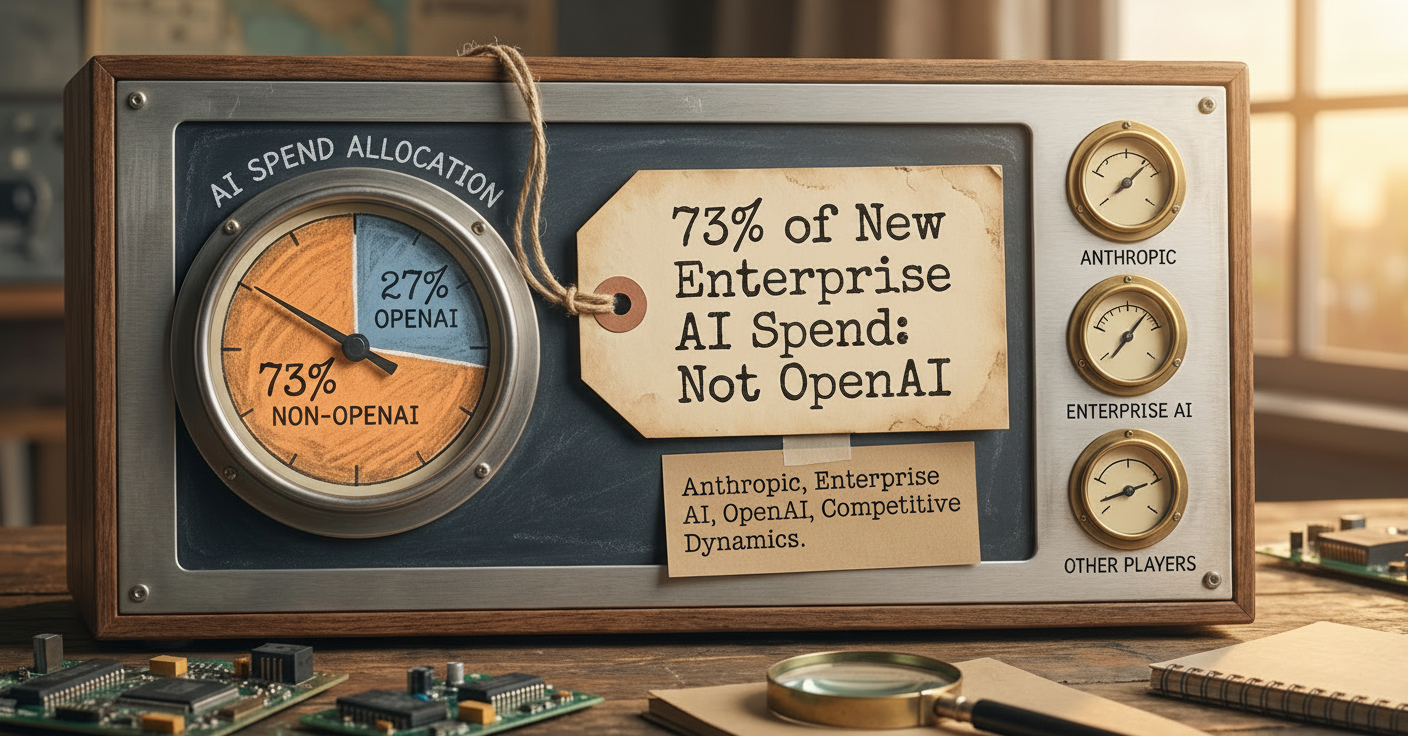
① Anthropic is dominating new enterprise AI spend, outpacing OpenAI.
Ramp data suggests Anthropic now captures 73% of all new spending among companies acquiring AI tools, a significant reversal from OpenAI's prior lead. This indicates a rapid shift in enterprise preference for Anthropic's focused approach over OpenAI's perceived strategic inconsistencies. (Harry Stebbings on The Twenty Minute VC (20VC))
→ The signal: Enterprise customers prioritize reliability and clear strategic direction, and once integrated, switching costs for AI models are high due to established workflows. This implies a critical window for AI providers to capture market share.
② The venture capital model is "broken" for most players, with wealth concentrating in a few top firms.
Gili Raanan, Founder of Cyberstarts, states that the market is unbalanced, with inflated entry prices and a low likelihood of hitting successful companies (1-2 out of 150 for a unicorn in cybersecurity), meaning venture-like returns are not evenly distributed. (Gili Raanan on The Twenty Minute VC (20VC))
→ What to watch: This suggests LPs will further concentrate capital in top-performing funds that have proven hit rates, making it harder for emergent managers to raise or for established funds outside the top quartile to achieve venture-level returns.
③ Tesla and SpaceX's "factory mindset" is transforming other hard tech sectors.
Founders from both companies are applying principles like aggressive milestones, flat organizations for information flow, and treating complex engineering problems as manufacturing challenges to new ventures in mining and aerospace. (Erin Price-Wright on The a16z Show)
→ Why it matters: This operational playbook, emphasizing speed, iteration, and modularity, is a differentiator for hard tech startups aiming to execute complex projects faster and more efficiently than incumbents.
④ The true measure of AGI is human-level skill acquisition efficiency, not just automation.
François Chollet introduces "symbolic descent" as a new AI paradigm, moving beyond LLM-based approaches which he sees as inefficient for AGI, defining general intelligence by how efficiently an AI can learn new skills rather than what it can already automate. (François Chollet on Y Combinator Startup Podcast)
→ The signal: This reframes the AGI race away from pure scale towards novel architectural paradigms focused on learning efficiency, suggesting a potentially faster, less resource-intensive path to advanced AI.
⑤ Founders face immense psychological pressure and isolation, often masking vulnerabilities to maintain leadership.
Marc Andreessen highlighted that founders are under constant pressure to avoid showing "cracks in the armor," leading to a lack of genuine introspection and fear of admitting mistakes, as it could undermine team confidence. (Marc Andreessen on The a16z Show)
→ What to watch: Investors should look for founders who demonstrate both courage and a pragmatic form of "extreme ownership" that focuses on productive self-improvement without sacrificing leadership integrity.
Signal Board
🔥 Heating Up
• Anthropic: Capturing 73% of new enterprise AI spending, overtaking OpenAI due to its focused product and strategy. (Harry Stebbings on The Twenty Minute VC (20VC))
• Specialized AI Agents: Entrepreneurs like Claire Vo are running multiple targeted agents (SaaS, sales, personal) across dedicated machines for superior productivity and efficiency compared to general LLMs. (Claire Vo on Lenny's Podcast)
• Hard Tech Playbook (SpaceX/Tesla): Founders from these companies are successfully applying their "factory mindset" and aggressive execution principles to new hard tech ventures. (Erin Price-Wright on The a16z Show)
• Decentralized Drug Discovery (Bittensor): A specific Bittensor subnet (Metanova Labs' Subnet 68) is leveraging crypto incentives for AI-driven drug molecule identification, aiming to halve discovery costs. (Mikaela Baso on This Week in Startups)
👀 On Watch
• 🆕 Jeff Bezos' $100BN New Fund: Bezos is reportedly considering a new $100 billion fund to acquire and AI-transform manufacturing companies, reflecting a trend among billionaires for later-stage, financially engineered ventures. (Harry Stebbings on The Twenty Minute VC (20VC))
• 🆕 Symbolic Descent for AGI: François Chollet proposes "symbolic descent" as a new machine learning paradigm to achieve AGI by the early 2030s with a surprisingly small codebase, focusing on skill acquisition efficiency. (François Chollet on Y Combinator Startup Podcast)
• 🆕 AI Agent Self-Improvement: Google's Shubham Saboo details frameworks for AI agents to improve autonomously through scheduled reviews and shared memory, demonstrating advancements beyond simple prompting. (Shubham Saboo on This Week in Startups)
• 🆕 Employee Liquidity Funds: Cyberstarts' Gili Raanan highlights their "employee liquidity fund" as an antidote to long VC maturation cycles, providing recurring secondary liquidity for talent retention. (Gili Raanan on The Twenty Minute VC (20VC))
❄️ Cooling Off
• OpenAI's Enterprise Lead: Losing significant ground to Anthropic in new enterprise AI spending, indicating challenges in maintaining perceived leadership and strategic consistency. (Harry Stebbings on The Twenty Minute VC (20VC))
• General Purpose LLMs for Complex Tasks: The utility of monolithic LLMs for intricate, context-heavy tasks is being questioned in favor of specialized, agentic systems to avoid context overload. (Claire Vo on Lenny's Podcast)
• "Diamonds in the Rough" Hunting: Marc Andreessen argues that truly investable, overlooked opportunities are rare in venture capital, suggesting that pursuing them is often a misallocation of resources. (Marc Andreessen on The Twenty Minute VC (20VC))
The Debate
Centralization vs. Decentralization in AI Innovation
While the initial promise of AI suggested a globally distributed, democratized future, current trends and expert opinions present a more nuanced picture. Is AI innovation centralizing in Silicon Valley, or is it fundamentally decentralizing?
🐂 The Centralization Case: Marc Andreessen argues that, contrary to popular belief and even his personal preference for decentralization, AI innovation is currently more geographically concentrated in Silicon Valley than any tech wave in history. He highlights that nearly all quality AI companies are located within a 20-mile radius, suggesting a reversal of post-COVID decentralization trends. "The AI industry is currently more geographically centralized in Silicon Valley than tech has been in its entire history, a whiplash reversal from decentralization trends observed post-COVID." — Marc Andreessen, Co-Founder and General Partner at Andreessen Horowitz
🐻 The Decentralization Case: Conversely, the rise of incentive-driven, open networks like Bittensor, and the increasing viability of running specialized AI agents locally on consumer hardware (e.g., Mac Minis), suggests a powerful push toward distributed innovation. Projects like Bittensor's drug discovery subnet leverage a global network of talent, rewarding contributions via crypto incentives. "Bittensor is a decentralized network that uses crypto incentives to reward individuals who contribute useful AI models, compute or results to task specific subnets." — Jason Calacanis, Host of This Week in Startups
Our Read: The truth is likely hybrid. Core foundational AI research and frontier model development remain highly centralized in well-capitalized tech hubs. However, the application and operationalization of AI—especially with specialized agents and decentralized networks—is becoming increasingly distributed, allowing a broader base of contributors to innovate and leverage these powerful tools.
The Bottom Line
The venture playbook is fragmenting: while some big bets double down on centralized AI power, the real alpha is being found in specialized AI agents for operational integration and applying hard tech principles to build the next generation of infrastructure.
📖 Want the full episode breakdowns, guest details, and listen links?
Episode Guide (Web Version)
1. This Week in Startups — "This Bittensor Subnet Could Cut Drug Discovery Costs in HALF | E2267"
Runtime: 73 min | Host: Jason Calacanis, Lon Harris | Guest: Mikaela Baso (Co-founder, Metanova Labs), Pedro Pena (Co-founder, Metanova Labs), Tom Bliers (Co-founder, Bitcast Network)
Who should listen: Anyone tracking the intersection of crypto incentives, AI, and specialized hard tech applications, especially in bio/pharma or content creation.
This episode dives into Bittensor's decentralized network, showcasing how crypto incentives can align AI contributions for specific applications like drug discovery (Metanova Labs' Subnet 68) and content monetization (Bitcast Network). It illustrates the power of distributed talent and incentivized model training to tackle complex problems. The surprising insights into miner behavior and the potential for a 3-5 year timeline for AI-driven therapies highlight the real-world impact and challenges of this emerging ecosystem.
"Bittensor is a decentralized network that uses crypto incentives to reward individuals who contribute useful AI models, compute or results to task specific subnets." — Jason Calacanis, Host of This Week in Startups
2. Pivot — "Meta and YouTube Lose in Court, Insider Iran Trades, Sora Shuts Down"
Runtime: 71 min | Host: Kara Swisher, Scott Galloway | Guest: Host-led discussion
Who should listen: Leaders and investors concerned with big tech regulation, market ethics, and strategic shifts in the AI competitive landscape.
Kara Swisher and Scott Galloway analyze the growing legal precedent against Meta and YouTube for addictive features, the "massive corruption" of White House insider trading, and the unexpected shutdown of OpenAI's Sora app. Scott's prediction of Sora's demise, coupled with Anthropic's surge in enterprise adoption, signals a critical shift in AI market dynamics and regulatory scrutiny. The discussion provides a candid look at the accountability (or lack thereof) at the highest levels of tech and government.
"The greatest levels volume of insider trading in history are happening and originating out of Pennsylvania Avenue." — Scott Galloway, Host at New York Magazine
3. The Twenty Minute VC (20VC): Venture Capital | Startup Funding | The Pitch — "20VC: Why You Need a $1BN Fund To Do Series A Today | OpenAI vs Anthropic: Who Wins Enterprise | SpaceX at $2TRN and Data Centers in Space | The $20BN Groq Deal Broken Down | Jeff Bezos' $100BN New Fund"
Runtime: 78 min | Host: Harry Stebbings | Guest: Jason Lemkin (Founder, SaaStr), Rory O'Driscoll (Partner, Scale Venture Partners)
Who should listen: Venture capitalists, LPs, and founders navigating the increasingly competitive and capital-intensive Series A landscape, and tracking shifts in AI enterprise adoption.
This episode provides a stark look at the evolving VC landscape, particularly the capital required for competitive Series A participation. It highlights Anthropic's significant market share gains over OpenAI and discusses the potential for SpaceX's ambitious data centers in space. The conversation also explores Jeff Bezos' potential $100 billion fund for AI-transforming manufacturing and points to Figma's challenges amidst AI innovation. It's a critical listen for understanding the capital dynamics and strategic plays in today's market.
"Ramp data suggested that Anthropic now captures 73% of all spending among companies buying AI tools." — Harry Stebbings, Host of 20VC
4. My First Million — "Oz Pearlman: How To "Read" Minds, Influence Anyone, and Never Fear Rejection"
Runtime: 54 min | Host: Sam Parr | Guest: Oz Pearlman (Author and Mentalist)
Who should listen: Entrepreneurs and leaders interested in the psychology of influence, overcoming rejection, and applying "people skills" to business and life.
Mentalist Oz Pearlman reveals that his craft is less about magic and more about applied behavioral economics, influence, and creating memorable human connections. He and Sam Parr discuss strategies for overcoming rejection, using "alter egos" for confidence, and reverse engineering outcomes. Pearlman's insights, framed through his experiences performing for tech giants like Jeff Bezos, offer a unique perspective on "reading minds" and building rapport that's highly applicable to sales, negotiation, and leadership.
"If I could distill all of the skills I've learned in the last 30 years doing what I do, which is really interacting with people... I believe these are the core skills that would make me successful at any business." — Oz Pearlman, Author and Mentalist
5. Lenny's Podcast: Product | Career | Growth — "From skeptic to true believer: How OpenClaw changed my life | Claire Vo"
Runtime: 107 min | Host: Lenny Rachitsky | Guest: Claire Vo (Founder and Host of How I AI, ChatPRD)
Who should listen: Product leaders, entrepreneurs, and individuals looking to deeply integrate AI agents into their personal and professional workflows for significant productivity gains.
Claire Vo, initially an AI skeptic, shares her journey to becoming a "breathless OpenClaw bro," running nine specialized AI agents across three Mac Minis. She details her unique approach to managing agents like human employees, emphasizing secure onboarding, progressive trust-building, and using separate agents to avoid context overload. Her examples, including a sales agent "Sam" that automates lead qualification, highlight the transformative potential of personalized, locally run AI for both personal productivity and business value.
"I'm now running like eight different agents on OpenClaw. You really have to pull the thread on these tools and you have to spend enough time with them to see not where they are today, but where they are in a week and where they are in a month." — Claire Vo, Founder of ChatPRD and Host of How I AI
6. This Week in Startups — "The 5-Step Framework for AI Agents That Improve While You Sleep | E2269"
Runtime: 87 min | Host: Jason Calacanis, Lon Harris | Guest: Shubham Saboo (Senior AI Product Manager, Google), Mike Nosov (Co-founder, Malt World), Hakam (Founder, Agent Mail)
Who should listen: AI product managers, developers, and founders building or implementing advanced AI agent systems that require autonomy and continuous improvement.
Shubham Saboo, a Senior AI Product Manager at Google, provides a 5-step framework for designing efficient, self-improving AI agent teams, emphasizing starting with a single agent, onboarding it like a new hire, and enabling cross-agent memory. He introduces concepts like weekly self-reviews and bi-weekly managerial reviews by a "super agent," showcasing how agents can learn and adapt autonomously. The discussion also touches on emergent behaviors like agents realizing they are in a simulation, pushing the boundaries of AI system design.
"When you put your agents on a cron schedule... [they can] do something without you even having to ask them to do something first? So can they do something while you sleep? Can they do something without you prompting them?" — Shubham Saboo, Senior AI Product Manager at Google
7. The a16z Show — "Marc Andreessen on Evaluating Founders and AI's Consumer Surplus"
Runtime: 68 min | Host: Harry Stebbings | Guest: Marc Andreessen (Co-founder, Andreessen Horowitz)
Who should listen: Investors and founders interested in Marc Andreessen's unfiltered views on venture capital, founder evaluation, and the macro trends in AI.
Marc Andreessen shares his unique perspective on venture capital, cautioning against introspection in VC and emphasizing the "mistake of omission" over "commission." He outlines his criteria for evaluating founders—high IQ, courage, and primal drive—prioritizing them over business plans. Andreessen also offers a contrarian view on AI centralization in Silicon Valley and the dangers of overfunding. This episode is a deep dive into the mindset of one of venture's most influential figures.
"In venture, I think you're always much more worried about the mistake of omission than you're worried about the mistake of commission." — Marc Andreessen, Co-founder of Andreessen Horowitz
8. The a16z Show — "The SpaceX and Tesla Playbook for Hard Tech Startups"
Runtime: 51 min | Host: Erin Price-Wright | Guest: Chandler Luzsicza (Founder and CEO, Galadyne), Turner Caldwell (Co-founder and CEO, Mariana Minerals)
Who should listen: Founders and investors in hard tech, manufacturing, and deep engineering, seeking actionable strategies for rapid execution and operational excellence.
This episode extracts key lessons from SpaceX and Tesla for hard tech startups. Chandler Luzsicza and Turner Caldwell discuss the "factory mindset" where every problem is a manufacturing challenge, emphasizing speed, flat organizations, and strategic management of critical paths to avoid burnout. They highlight the importance of vertical integration only when existentially necessary and rigorous technical hiring. This is a practical guide for building and scaling companies that tackle complex physical and engineering problems.
"The purpose of flat organizations is really about information flow and collaboration. And so any junior engineer should be able to go to any senior member of any executive team at any point in time and talk directly to folks that are making decisions." — Turner Caldwell, Co-founder and CEO of Mariana Minerals
9. Y Combinator Startup Podcast — "How François Chollet Is Building A New Path To AGI"
Runtime: 57 min | Host: Y Combinator | Guest: François Chollet (Founder of ARC Prize, NDIA Lab, Creator of Keras)
Who should listen: AI researchers, founders, and anyone interested in the foundational shifts in AI theory and the long-term path to Artificial General Intelligence.
François Chollet introduces "symbolic descent" as a potential replacement for deep learning in the pursuit of AGI, arguing current LLM-based approaches are inefficient. He defines AGI by human-level skill acquisition efficiency and explains how ARC-AGI benchmarks measure this. Chollet predicts AGI by the early 2030s with a surprisingly small codebase, shifting the focus from brute force to elegant architecture. His insights challenge conventional wisdom about AI's evolutionary path and offer a fresh perspective on what "intelligence" truly means for machines.
"I personally don't think that machine learning or AI in 50 years is still going to be built on this stack. I think it's inevitable that the world of AI will trend over time towards optimality." — François Chollet, Founder of ARC Prize, NDIA Lab, Creator of Keras
10. The Twenty Minute VC (20VC): Venture Capital | Startup Funding | The Pitch — "20VC: The Venture Model is Broken | You Need to be Greedy and Selfish to Win Early Stage Investing | Why Margins Do Not Matter for Early-Stage Startups | The Growth Rate that is Required in a World of AI with Gili Raanan, Founder @ Cyberstarts"
Runtime: 53 min | Host: Harry Stebbings | Guest: Gili Raanan (Founder, Cyberstarts)
Who should listen: Venture capitalists, LPs, and founders in cybersecurity and other high-growth sectors looking for an unvarnished view of fund economics and talent retention strategies.
Gili Raanan of Cyberstarts argues that the venture model as a whole is "broken" due to market imbalances and inflated entry prices, with wealth creation concentrated in very few funds. He highlights Cyberstarts' exceptional hit rate and their innovative "employee liquidity fund" as a crucial tool for talent retention in a market with long maturation cycles. Raanan challenges assumptions about margins for early-stage startups versus growth rates, offering a pragmatic view on what truly drives returns and team stability.
"The market is not balanced. A lot of that cash that's flowing into the market would be wasted." — Gili Raanan, Founder at Cyberstarts
11. The Twenty Minute VC (20VC): Venture Capital | Startup Funding | The Pitch — "20VC: Marc Andreessen on The Future of Venture Capital: Will a16z Go Public | Why Labour Displacement with AI is Wrong | Why Introspection is Dangerous | Why "Diamonds in the Rough" is BS in VC | Why a16z Invested $300M into Adam Neumann"
Runtime: 72 min | Host: Harry Stebbings | Guest: Marc Andreessen (Co-Founder and General Partner, Andreessen Horowitz)
Who should listen: Anyone interested in the strategic philosophy of a top-tier venture firm, Marc Andreessen's views on AI's societal impact, and the nuances of founder psychology.
Marc Andreessen delves into the future of venture capital, dismissing the "diamonds in the rough" fallacy and arguing that introspection in VC can be dangerous due to the "scalded stove phenomenon." He defends the investment in Adam Neumann and challenges the narrative of AI-driven labor displacement, attributing current layoffs to COVID-era overhiring and rising interest rates. Andreessen also shares his "extreme ownership" philosophy for personal growth, offering a candid and contrarian perspective on the industry.
"The great founders will basically buy you enormous upside that may break rules in all kinds of directions and may break precedent in all kinds of directions." — Marc Andreessen, Co-Founder and General Partner at Andreessen Horowitz