
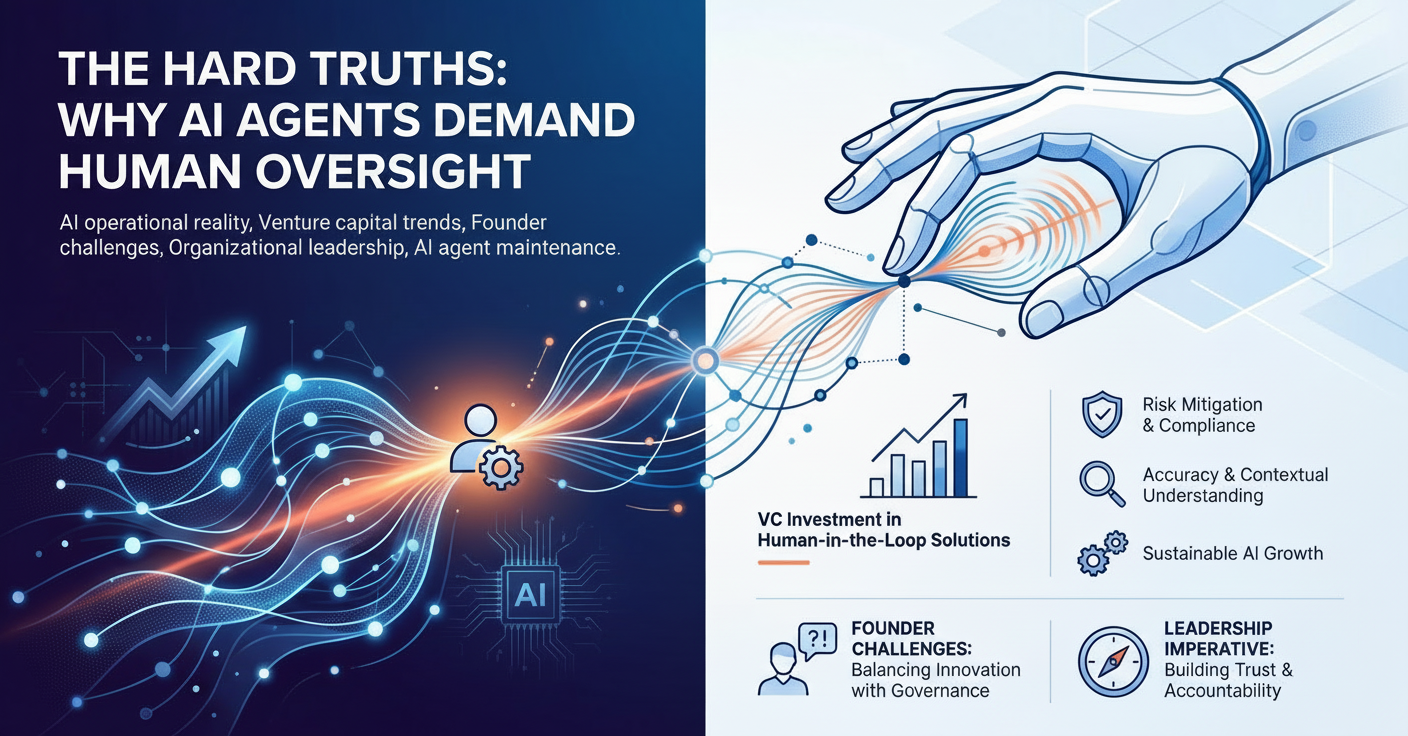
The venture market is buzzing with talk of AI, but the real intelligence comes from those navigating its practical application—and the uncomfortable truths about what's actually clearing.
The Intake
Where capital is flowing. What's getting funded. Insight from operators in the trenches.
This week's pattern recognition:
📊 10 episodes across 8 podcasts
⏱️ 607 minutes with GPs, founders, and LPs
🎙️ The voices: Dr. Becky Kennedy (Clinical Psychologist, Good Inside), Lenny Rachitsky (Host, Lenny's Podcast), Oren Zeev (Solo Capitalist, Zeev Ventures), Tyler Denk (Founder, Beehiiv)
The Big Shift
AI Agents are Delivering ROI, But the Cost of Maintenance is Substantial
SaaStr's CEO, Jason Lemkin, and CAIO, Amelia Lerutte, revealed their internal use of over 20 AI agents has generated $4.8M in additional pipeline and nearly doubled win rates. This isn't theoretical; it's proven conversion at scale. However, the often-overlooked truth is the immense resource allocation required: Lerutte spends 15-20 hours per week maintaining these "AI employees." Organizations expecting AI agents to be 'set it and forget it' are in for a rude awakening, as the operational overhead for optimization and orchestration is significant, forming a new category of internal labor.
Why it matters: The ROI for AI agents in GTM is real and measurable for early adopters. But the human-in-the-loop requirement is much higher than widely accepted, adding a new line item to the P&L for "AI agent maintenance." Don't assume automation means zero human effort.
"The agents and the humans have to rapidly evolve and change constantly. Like it's such a mind share killer for myself or Jason. Like we're in these agents, you know, I think 15 to 20 hours a week each." — Amelia Lerutte, Chief AI Officer at SaaStr (The Official SaaStr Podcast)
The move: Before deploying AI agents, map out the human resources required for ongoing maintenance and optimization, and factor that into your immediate ROI calculation.
The Rundown
① Focus on 'Radical Alignment' to Cut VC Management Fees. Oren Zeev, a solo capitalist overseeing $1BN AUM, operates with zero management fees, taking 30% carry, and often being the largest LP in his own funds. (Oren Zeev on The Twenty Minute VC)
• Why it matters: This model, though rare, flips the traditional VC fee structure, aligning GP incentives directly with LP returns and potentially leading to higher net returns for LPs.
② Founders are still over-prioritizing fundraising over product validation. Many early-stage teams incorrectly focus on raising capital before achieving substantive product-market fit, despite modern tools enabling significant validation with minimal funds. (William P. Barnes on This Week in Startups)
• The signal: Founders who can demonstrate product validation and customer obsession with "vibe coding" or clickable mockups will stand out in a tighter fundraising environment.
③ The 'Mythical Man-Month' is breaking with AI. Ben Horowitz notes that AI drastically changes the competitive dynamics in tech; companies with proprietary data and ample GPUs can now "throw money at the problem" and rapidly catch up, challenging traditional notions of product defensibility. (Ben Horowitz on The a16z Show)
"If you have data, particularly proprietary data, and you have enough GPUs, you can solve like almost any problem. It is magic, but it means that you can throw money at the problem. And we've never had that in tech." — Ben Horowitz, Co-founder at Andreessen Horowitz (The a16z Show)
• What to watch: This could lead to a faster pace of innovation and disruption, but also higher capital intensity in AI-driven sectors.
④ Building a "marketing kill shot" story is key for early-stage growth. Tyler Denk of Beehiiv leveraged his past experience and a compelling story to rapidly acquire early customers, highlighting that storytelling often precedes revenue. (Tyler Denk on My First Million)
• Why it matters: In crowded markets, a clear narrative that showcases founder-market fit can be more effective than early sales in driving initial traction and attracting talent.
⑤ Generational shifts are pushing for clear boundaries and "Sturdy Leadership". Dr. Becky Kennedy's framework argues that both children and adults secretly crave strong, decisive leaders who provide security, even if they initially push back. (Dr. Becky Kennedy on Lenny's Podcast)
• The signal: Leaders able to balance empathy with clear boundaries will foster resilient teams, crucial for navigating ongoing market uncertainty.
Capital Signals
🔥 HOT
• AI Agent Orchestration: Multi-agent systems are driving significant GTM pipeline and win rates, though human oversight is critical. (Amelia Lerutte on The Official SaaStr Podcast)
• Proprietary Data + GPUs: This combination is identified as the new magic for solving complex tech problems and accelerating product development. (Ben Horowitz on The a16z Show)
👀 EMERGING
• 🆕 Hyper-segmentation in AI SDRs: Moving beyond broad categories to dynamic campaigns for significantly higher conversion. (Jason Lemkin on The Official SaaStr Podcast)
• Zero Management Fee VC: Oren Zeev's model champions extreme LP-GP alignment through 0% management fees and higher carry. (Oren Zeev on The Twenty Minute VC)
🧊 COOLING
• Website Builders: VCs remain skeptical about identifying winners in this crowded category, especially those focusing solely on design over broader utility. (Charles Hudson on The Pitch)
• Hyper-growth Expectations: The belief that all incumbents will be disrupted by AI is being challenged, particularly for operationally complex businesses. (Oren Zeev on The Twenty Minute VC)
⚠️ CROWDED
• Unscalable Development: The challenge of automating away human tasks, even with advanced AI, leads to significant unscalable components. (Amelia Lerutte on The Official SaaStr Podcast)
• AI Infrastructure (as investment thesis): While powerful, the ability to "throw money at the problem" with data and GPUs means leads can evaporate quickly, making current advantages less secure. (Ben Horowitz on The a16z Show)
The Debate
Is achieving product-market fit (PMF) still a prerequisite for significant funding in new categories like AI?
🐂 The bull case:
"A long time ago you would have to raise a lot of money and then build all this infrastructure...Through a whole range of technology, you can now do a lot of that validation without needing a lot of money." — William P. Barnes, Partner at Carmen Ventures (This Week in Startups)
🐻 The bear case:
"I just really struggle with the competitive landscape in this category... I have not had much success in picking which of the teams starting from that day, zero who have beautiful products are going to win." — Charles Hudson, Investor at Precursor Ventures (The Pitch)
Our read: While it's easier than ever to simulate PMF with less capital, the bar for proven PMF in crowded categories remains high. Smart money is looking for clear customer validation beyond just a beautiful product, particularly in "AI-flavored" areas where differentiation is hard.
The Bottom Line
The operational reality of AI is more complex—and expensive—than the hype suggests, creating a new set of competitive moats for those who can execute.
🎯 Your Move
- Audit your AI deployment plans: Factor in significant human-in-the-loop maintenance for AI agents, as initial promises of full automation are not holding true.
- Double down on narrative for early traction: Invest in compelling storytelling that establishes founder-market fit and a clear "why" to stand out from aesthetically pleasing but undifferentiated products.
- Re-evaluate your product defensibility strategy: In an AI-accelerated world, proprietary data and GPU access can allow competitors to rapidly close gaps, so focus on deeper, more ingrained advantages.
What We Listened To
1. The Pitch: "#176: Your AI Website Sucks. PeachWeb is the Future"
Guests: Josh Muccio (Host, The Pitch), Lisa Muccio (Co-Host, The Pitch), Lucas (Founder, PeachWeb), Charles Hudson (Investor, Precursor Ventures), Elizabeth Yin (Investor, Hustle Fund), Jesse Middleton (Investor, Flybridge), Don Dobras (Investor, Capital F), Elizabeth (Unspecified Role), Jesse (Unspecified Role) Runtime: 34 min | Vibe: A reality check on differentiating in crowded AI markets
Key Signals:
- Website Builder Scrutiny: Investors express significant skepticism about the crowded website builder market, prioritizing broader application capabilities and speed-to-market over niche design specialization, despite impressive aesthetics.
- Corporate VC Signal: Despite VC reservations, a bootstrapped AI website builder (PeachWeb) secured significant funding from a corporate VC, highlighting a different risk appetite or strategic interest than traditional VCs.
- 3D Web as a Standout: The pitch argues WebGL-enabled 3D websites are crucial for standing out, indicating a potential niche trend towards immersive web experiences as differentiation.
"He's not competing with AI products, he's competing with anybody who is offering a website alternative. So whether you get it done with an AI product or whether you get it done, whatever it is, like that's what he's competing with. And it's just so competitive." — Josh Muccio, Host of The Pitch
2. The Twenty Minute VC (20VC): Venture Capital | Startup Funding | The Pitch: "20VC: 50% of Funds Will Go Out of Business | Why Growth Expectations Today are BS and Will Not Last | Why Oren Zeev Takes $0 Management Fees But 30% Carry | Why GPs Should Not Tell LPs Their Strategy"
Guests: Oren Zeev (Solo Capitalist, Zeev Ventures), Harry Stebbings (Host, 20VC) Runtime: 68 min | Vibe: A contrarian masterclass in VC alignment and conviction
Key Signals:
- Radical GP-LP Alignment: Oren Zeev’s model—zero management fees, 30% carry, and being the largest LP in his own funds—signals an extreme shift towards direct alignment with investor returns, challenging traditional fund structures.
- Sustainable Growth vs. Hype: Zeev advocates for healthy, sustainable growth over "hyper-growth" metrics, dismissing common narratives about AI's immediate disruptive power for operationally complex incumbents.
- Concentration Over Diversification: Zeev views fund-level diversification as overrated, preferring concentrated investments for GPs, suggesting LPs should diversify across funds, not within them.
"I prefer a company that's growing 2x with very healthy economics than a company that's going 3x with unhealthy economics." — Oren Zeev, Solo Capitalist at Zeev Ventures
3. My First Million: "How I went from $0 to $1M in 12 months"
Guests: Shaan Puri (Host, My First Million), Tyler Denk (Founder, Beehiiv), Tyler (Founder, Big Desk Energy) Runtime: 55 min | Vibe: Unscalable tactics for rapid early-stage growth
Key Signals:
- Founder-Market Fit as Marketing Kill Shot: Leveraging personal credibility and a strong "kill shot" story by the founder is highlighted as crucial for rapid early traction, even before full product development.
- "Do Things That Don't Scale" for Superfans: Manual customer engagement, direct outreach, and even a "high-friction" signup process can create deeply loyal early adopters and product differentiation.
- Prioritizing "Marketable" Features: Focusing on features that generate buzz and enable "building in public" can lead to stronger community engagement and organic growth in the early stages.
"In the early days, all you really have is that story. Storytelling, I think, is the biggest asset as a founder, especially in the early days, because that's before revenue, before customers, before attraction." — Tyler Denk, Founder at Beehiiv
4. The Official SaaStr Podcast: SaaS | Founders | Investors: "SaaStr 840: From 1 Agent to 20+: The Reality of Managing Multiple AI Agents Across Your GTM with SaaStr's CEO and CAIO"
Guests: Jason Lemkin (CEO and Founder, SaaStr), Amelia Lerutte (Chief AI Officer, SaaStr) Runtime: 63 min | Vibe: The operational realities of AI agent deployment
Key Signals:
- Proven AI Agent ROI with High Maintenance: SaaStr's internal data shows $4.8M in additional pipeline and nearly doubled win rates from 20+ AI agents, but each agent requires 15-20 hours/week in maintenance.
- 90/10 Build vs. Buy Rule: For AI tools, 90% should be off-the-shelf, with only 10% custom-built, contradicting the instinct to build proprietary solutions for competitive advantage.
- Hyper-segmentation for AI SDRs: Effective AI sales agents require dynamic, context-rich segmentation beyond traditional broad categories, focusing on "hot" leads for optimal results.
"we have now eight months in 4.8 million accounting and additional in additional pipeline source via agents. Our win rate has nearly doubled." — Amelia Lerutte, Chief AI Officer of SaaStr
5. Lenny's Podcast: Product | Career | Growth: "A child psychologist’s guide to working with difficult adults | Dr. Becky Kennedy"
Guests: Dr. Becky Kennedy (Clinical Psychologist, Author, and CEO, Good Inside), Lenny Rachitsky (Host), Lenny (Host) Runtime: 92 min | Vibe: Leadership lessons from child psychology
Key Signals:
- "Sturdy Leadership" in Corporate Settings: Applying child psychology principles reveals that employees, like children, crave strong, decisive leaders who balance emotional validation with clear boundaries, providing security and direction.
- "Most Generous Interpretation" (MGI): Assuming good intent and interpreting "bad behavior" as a lack of skills to manage feelings can transform leadership approaches from punitive to developmental, fostering trust and growth.
- The Power of Repair: Leadership effectiveness isn't about avoiding mistakes, but actively "repairing" trust and relationships after errors, which is crucial for building resilient teams and culture.
"Bad behavior at any age can basically be reduced to feelings that overpower skills. And yes, behavior is a problem, but behavior isn't the core problem. It's a manifestation of the problem, the actual problem is someone doesn't have the skill they need to manage something happening internally." — Dr. Becky Kennedy, Child Psychologist and Founder of Good Inside
6. This Week in Startups: "Where early-stage founders MUST focus to success | E2244"
Guests: Jason Calacanis (Host, This Week in Startups), Amanda Bradford (Founder of The League, The League (acquired by Match.com)), William P. Barnes (Partner, Carmen Ventures), Amanda (Founder, The League) Runtime: 67 min | Vibe: Practical guide for early-stage founder priorities
Key Signals:
- Product Validation Over Fundraising: Modern tools allow extensive product validation (like clickable mockups) with minimal capital; founders often incorrectly prioritize fundraising over achieving early product-market fit.
- Trust as a Core Product Feature: Building reliability and trust, even through unscalable manual processes (like vetting every applicant for a dating app), is essential for early adoption and high engagement.
- Constraint Drives Innovation: Limitations in resources can force founders to be more innovative and efficient, leading to unconventional strategies for growth and problem-solving.
"A long time ago you would have to raise a lot of money and then build all this infrastructure, whether it's like servers, HR, people, legal... Through a whole range of technology, you can now do a lot of that validation without needing a lot of money." — William P. Barnes, Partner at Carmen Ventures
7. The a16z Show: "Palmer Luckey on Hardware, Building, and the Next Frontiers of Innovation"
Guests: Chris Dixon (General Partner, Andreessen Horowitz), Palmer Luckey (Founder, Anduril and Oculus VR) Runtime: 62 min | Vibe: Hardware innovation and defense tech futures
Key Signals:
- "Repelling the Wrong People" in Hiring: Anduril's recruiting strategy focuses on actively deterring candidates not fully committed to the mission and challenges, ensuring a highly aligned and dedicated workforce.
- Independent Product Teams for Scale: Running lean, independent product teams for numerous products is deemed easier to manage and scale than focusing on one or two large, all-encompassing products.
- Academic Literature as Outsourced R&D: Palmer Luckey relies heavily on academic reading across diverse fields to stay updated, treating it as an "outsourced research team" rather than traditional media.
"It is important to get the right people. It's even more important to repel the wrong people, no matter how well they dress themselves up and hide their true nature." — Palmer Luckey, Founder of Anduril and Oculus VR
8. Founders: "#411 Tortured Into Greatness: The Life of Andre Agassi"
Guests: David Senra (Host, Founders Podcast), Andre Agassi (Professional Tennis Player), Brad Gilbert (Tennis Coach), JP (Confidant and Friend) Runtime: 61 min | Vibe: The psychological cost of greatness and resilience
Key Signals:
- The Paradox of Success: Andre Agassi’s deep hatred for the sport he mastered underscores a profound internal conflict between external achievement and personal fulfillment.
- Mentorship Beyond Performance: The narrative highlights the critical role of mentors (like "JP" and Brad Gilbert) in navigating personal crises and helping find purpose beyond individual success.
- Cost Control as a Permanent Advantage: Drawing a parallel to Andrew Carnegie, the episode emphasizes that unlike cyclical profits and prices, savings achieved through strict cost control are permanent, a crucial insight for founders.
"This is a very unusual autobiography where you have somebody that literally becomes the person that's the best in the world at what he does, and he hates the thing that he does." — David Senra, Host at Founders Podcast
9. My First Million: "My decision-making framework for which ideas to chase"
Guests: Shaan Puri (Host, My First Million), Sam Parr (Host, My First Million) Runtime: 68 min | Vibe: Philosophical take on entrepreneurial decision-making
Key Signals:
- The "Yes Test" for Passion Projects: Shaan Puri advocates pursuing projects you'd "do for free or even at a loss," indicating strong intrinsic motivation leads to the best long-term outcomes.
- Bigger Ideas Attract Better Talent: The principle "the bigger your idea, the better people you can recruit" suggests that ambitious visions are naturally appealing to high-caliber talent, easing the execution burden.
- Values Over Short-Term Profit: Emphasizing long-term vision and sticking to values, rather than bending them for short-term commercial gain, leads to more profitable and fulfilling endeavors.
"The best projects in my life have been things where I've said yes to things that I would be willing to do for free or willing to lose money." — Shaan Puri, Host of My First Million
10. The a16z Show: "David Solomon & Ben Horowitz on Building Organizational Resilience & Navigating Macro Uncertainty"
Guests: David Haber (General Partner, Andreessen Horowitz), David Solomon (Chairman and CEO, Goldman Sachs), Ben Horowitz (Co-founder, Andreessen Horowitz) Runtime: 37 min | Vibe: Macroeconomics, AI, and organizational strategy
Key Signals:
- Confidence Driving M&A/IPOs: David Solomon predicts a potentially record-breaking M&A and IPO year, signaling a shift in CEO confidence from "no" to "maybe" on large transactions.
- AI's Impact on Competitive Moats: Ben Horowitz highlights that AI, with proprietary data and GPUs, can rapidly erode competitive leads, enabling companies to quickly catch up by "throwing money at the problem."
- Fragmented AI Regulation Risk: Solomon warns that diverse state-level AI laws will stifle innovation, making compliance impossible for new companies and potentially hindering AI development in the US.
"If you have data, particularly proprietary data, and you have enough GPUs, you can solve like almost any problem. It is magic, but it means that you can throw money at the problem. And we've never had that in tech." — Ben Horowitz, Co-founder of Andreessen Horowitz